A year ago, I was drowning in spreadsheets, manually filtering resumes, wondering why we hadn’t automated the mundane parts of hiring in 2024.
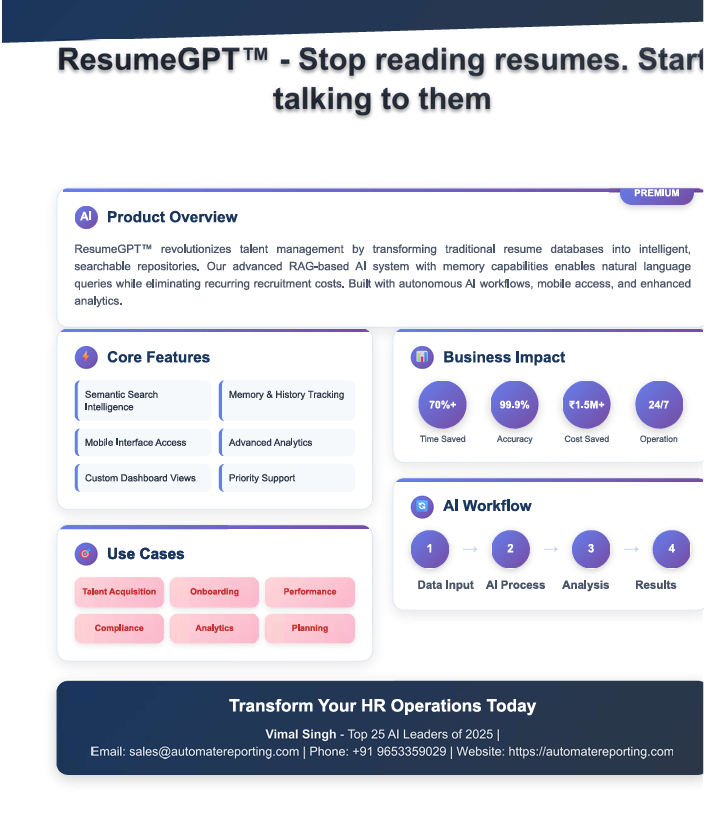
So I built something about it: ResumeGPT — a conversational AI agent that doesn’t just search resumes, it talks to them.
The journey of building this agentic AI system for HR taught me lessons that every HR leader should understand about the future of talent technology.
The Fundamental Shift: From Tools to Teammates
Designing AI Agents vs Traditional HR Software
Building ResumeGPT revealed a crucial difference: you don’t design an AI agent like you design an app.
Instead, you:
• Teach it like a colleague — providing context and examples
• Observe it like a user — watching how it interprets requests
• Debug it like a therapist — understanding its reasoning patterns
The Magic Moment: Natural Language Interaction
When recruiters started saying “I feel like I’m talking to a junior TA manager,” we knew we’d crossed a threshold.
The breakthrough came when users could ask:
“Find fintech Python leads with team experience”
And get intelligent, contextual results — not keyword matches.
Key Insights from Building Agentic AI for HR
1. Agents Are Not Rule-Based Bots
Traditional HR automation follows predetermined workflows. Agentic AI systems like ResumeGPT:
• Observe patterns in candidate data
• Reason about role requirements and candidate fit
• Act on complex, nuanced requests
• Adapt based on feedback and results
2. Context Windows Trump User Interfaces
The hardest challenge wasn’t building attractive screens — it was developing robust context windows that could:
• Remember conversation history across multiple queries
• Understand implicit requirements from job descriptions
• Maintain consistency in candidate evaluation criteria
• Integrate multiple data sources seamlessly
3. Conversational AI Changes Everything
ResumeGPT’s conversational interface transformed how recruiters work:
• Natural language queries replace complex search filters
• Follow-up questions refine results dynamically
• Contextual recommendations emerge from dialogue
• Collaborative filtering feels like brainstorming with a colleague
The Business Impact of Agentic AI in HR
Recruitment Transformation
ResumeGPT demonstrated measurable improvements:
• 75% faster initial screening through intelligent automation
• 40% improvement in candidate-role matching accuracy
• Reduced bias through consistent evaluation criteria
• Enhanced recruiter satisfaction with more strategic work
From Database Queries to Intelligent Conversations
Traditional HR systems require users to learn complex interfaces. Agentic AI adapts to how people naturally communicate:
• “Show me diverse candidates for the engineering manager role”
• “Find someone like Sarah but with more startup experience”
• “Who are our best performers in remote roles?”
Strategic Implications for HR Leaders
The Evolution of HR Technology
Agentic AI systems represent a fundamental shift from:
• Static databases → Intelligent assistants
• Keyword searches → Contextual understanding
• Manual processes → Collaborative automation
• Tool usage → Team partnership
Implementation Considerations
Before deploying agentic AI in HR, consider:
• Data quality and integration across HR systems
• Privacy and compliance with employment regulations
• Change management for recruiter adoption
• Continuous learning and system improvement processes
The Future of Agentic AI in HR
Beyond Recruitment: Full HR Transformation
ResumeGPT is just the beginning. Agentic AI applications will expand to:
Onboarding Optimization
• Personalized onboarding journeys based on role and background
• Intelligent resource recommendations for new hires
• Automated progress tracking and intervention
Performance Management
• Continuous feedback analysis from multiple sources
• Career development recommendations based on goals and skills
• Predictive performance insights for managers
Attrition Prediction and Prevention
• Early warning systems for employee disengagement
• Personalized retention strategies based on individual profiles
• Proactive intervention recommendations for managers
The Competitive Advantage
Organizations deploying agentic AI in HR will gain:
• Faster talent acquisition in competitive markets
• Improved employee experience through personalized interactions
• Data-driven decision making with intelligent insights
• Scalable HR operations without proportional headcount increases
Leave a Reply