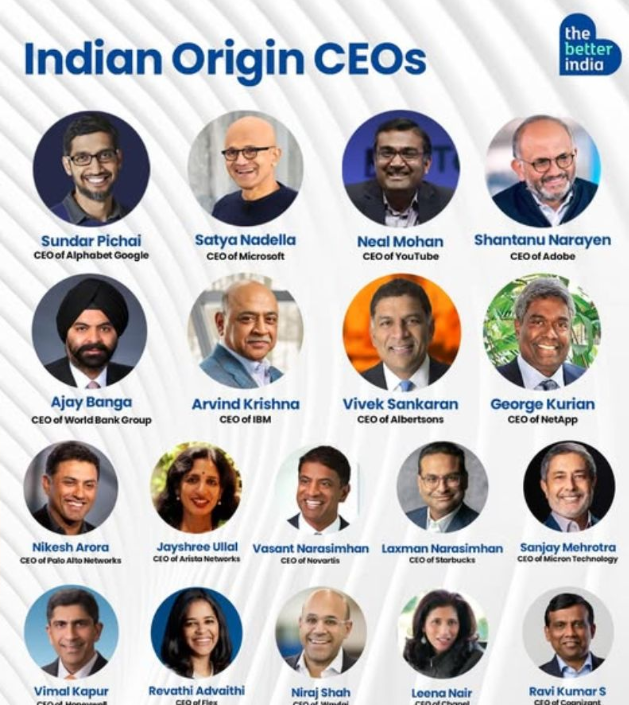
How the world’s most talented tech leaders are Indian, yet India remains on the sidelines of the AI revolution – and why that might change everything
The Stunning Reality: Indian CEOs Rule Silicon Valley
Take a moment to scan the leadership of the world’s most powerful tech companies. The pattern is impossible to ignore:
Microsoft – Satya Nadella 🇮🇳Google – Sundar Pichai 🇮🇳YouTube – Neal Mohan 🇮🇳IBM – Arvind Krishna 🇮🇳Palo Alto Networks – Nikesh Arora 🇮🇳Flex – Revathi Advaithi 🇮🇳Micron Technology – Sanjay Mehrotra 🇮🇳Arista Networks – Jayshree Ullal 🇮🇳Cadence Design – Anirudh Devgan 🇮🇳NetApp – George Kurian 🇮🇳Cognizant – Ravi Kumar S 🇮🇳Perplexity – Aravind Srinivas 🇮🇳
The list goes on. Indian-origin executives don’t just participate in Silicon Valley – they lead it. These aren’t token appointments or diversity hires. These are the architects of the global digital economy, the decision-makers shaping how billions of people interact with technology daily.
Yet here’s the paradox that keeps me up at night: If Indians are so brilliant at running Big Tech, why isn’t India leading Big Tech innovation?
The Numbers Tell a Stark Story
The contrast between Indian leadership abroad and Indian innovation at home is jarring:
R&D Investment:
- India: 0.65% of GDP
- China: 2.7% of GDP
- United States: 3.5% of GDP
AI Startup Funding (2024):
- India: $780 million
- United States: $97 billion
That’s not a typo. The US raised 124 times more AI funding than India in 2024. For a country with 1.4 billion people and a massive tech workforce, these numbers are stunning.
The Talent Pipeline That Conquers the World
Let’s be clear about something: India’s tech talent is extraordinary. At IBM, where I’ve worked closely with global teams, one in three employees is based in India. These aren’t just engineers filling quotas – they’re some of the most innovative, hardworking, and strategic minds I’ve encountered.
Indian institutes like IIT produce graduates who walk into top positions at Google, Microsoft, and Amazon. Indian professionals don’t just work at these companies; they often become the backbone of critical projects, leading teams that build products used by billions.
The depth of skill is undeniable. The scale is massive. So what’s missing?
The Language Labyrinth: India’s Unique Challenge
One major barrier is linguistic complexity that most countries simply don’t face. India has:
- 22 official languages
- 19,500 distinct dialects
- Hundreds of millions of speakers across different linguistic families
For AI development, this creates a nightmare scenario. Foundation models need clean, structured data sets. While English-language AI can train on decades of digitized content, Indian language models face fragmented, incomplete datasets across dozens of languages.
Imagine trying to build ChatGPT when your training data is scattered across Tamil, Hindi, Bengali, Telugu, Marathi, Gujarati, and fifteen other major languages – each with different scripts, grammar structures, and cultural contexts.
This isn’t just a technical challenge; it’s a structural disadvantage in the current AI landscape.
The Innovation Ecosystem Gap
But language alone doesn’t explain the gap. The real issue runs deeper: India optimized for execution, not invention.
For decades, India’s tech strategy was brilliant but narrow. The country became the world’s back office, the place where American and European companies could find incredible talent at competitive costs. Indian IT services companies like TCS, Infosys, and Wipro became global giants by executing other people’s ideas flawlessly.
This model created enormous wealth and established India as a tech powerhouse. But it also created a mindset focused on perfecting existing solutions rather than creating breakthrough technologies.
The execution-first culture has benefits:
- Incredible attention to detail
- Ability to scale rapidly
- Cost-effective development
- Reliable delivery
But it also has limitations:
- Less appetite for high-risk R&D
- Preference for proven models over experimental approaches
- Focus on incremental improvement over breakthrough innovation
- Conservative funding environment
The R&D Investment Reality Check
The 0.65% R&D spending figure isn’t just a number – it represents a fundamental choice about where India directs its resources. Compare this to:
- Israel: 4.9% of GDP on R&D
- South Korea: 4.8% of GDP
- Japan: 3.3% of GDP
These countries made deliberate decisions to prioritize research and development. They created ecosystems where experimentation, failure, and breakthrough innovation are not just tolerated but encouraged.
India, meanwhile, has focused on education, infrastructure, and service delivery – all important, but not sufficient for leading the next wave of technological innovation.
Why This Matters More Than Ever
The AI revolution isn’t just another tech trend. It’s a fundamental shift in how value is created in the global economy. Countries that lead in AI will have enormous advantages in:
- Economic competitiveness
- National security
- Cultural influence
- Standard setting
Right now, the AI conversation is dominated by American companies (OpenAI, Google, Microsoft) and Chinese companies (ByteDance, Baidu, Alibaba). European companies are trying to catch up. Indian companies are barely in the conversation.
This is particularly frustrating because many of the breakthrough AI innovations are being led by Indian-origin executives and engineers – they’re just not happening in India.
The Untapped Potential: What India Could Achieve
Here’s what keeps me optimistic: India has advantages that other countries would kill for.
Massive Domestic Market: India’s 1.4 billion people represent the world’s largest potential user base for AI applications. Local solutions for Indian problems could scale to serve hundreds of millions of users.
Diverse Problem Sets: India faces unique challenges in healthcare, education, agriculture, and governance. AI solutions for these problems could be exportable to other developing nations worldwide.
Cost-Effective Innovation: Indian engineers can build AI solutions at a fraction of Silicon Valley costs, making advanced AI accessible to markets that American companies ignore.
Government Digital Infrastructure: Initiatives like Aadhaar, UPI, and Digital India have created a foundation for AI deployment that few countries can match.
The Signs of Change Are Already Here
Despite the challenges, there are encouraging signals:
Emerging AI Startups: Companies like Ola Electric, Nykaa, and byju’s are integrating AI into their core business models, not just using it as a feature.
Government Recognition: The National AI Strategy and AI for All initiatives show policy awareness of AI’s importance.
Corporate Investment: Indian companies like Reliance and Tata are making significant AI investments.
Talent Retention: Some Indian engineers are choosing to build startups in India rather than moving to Silicon Valley.
The Cultural Shift That’s Needed
For India to become an AI leader, it needs more than just investment – it needs a cultural transformation:
From Risk-Averse to Risk-Taking: Indian business culture tends to favor proven approaches. AI innovation requires comfort with failure and experimentation.
From Services to Products: The services mindset focuses on client requirements. Product innovation requires internal vision and long-term thinking.
From Cost Leadership to Value Creation: Competing on cost has limits. Leading in AI requires creating unique value that commands premium pricing.
From Local Optimization to Global Thinking: Indian solutions often focus on local markets. AI leadership requires building products for global scale from day one.
Why the Next Decade Could Belong to India
Despite current challenges, I remain optimistic about India’s AI future. Here’s why:
The Talent Pipeline Is Unmatched: India produces more engineering graduates than any other country. As AI becomes more democratized, this talent advantage will become crucial.
The Problem-Solution Fit: India’s complex challenges require innovative AI solutions. Countries that solve hard problems often create the most valuable technologies.
The Cost-Innovation Balance: As AI development costs decrease, India’s cost advantages in talent and infrastructure become more valuable.
The Market Opportunity: Companies that crack the Indian market often have solutions that work globally, especially in developing nations.
The Path Forward: Three Critical Changes
For India to realize its AI potential, three things need to happen:
1. Massive R&D Investment
India needs to at least double its R&D spending to 1.3% of GDP within five years, with specific focus on AI research centers and university partnerships.
2. Risk Capital Formation
Indian investors need to embrace the high-risk, high-reward nature of AI innovation. This means being comfortable with failures and betting on breakthrough technologies.
3. Talent Retention and Repatriation
India needs to create opportunities compelling enough to keep its best minds at home and attract Indian talent back from Silicon Valley.
A Personal Observation
Having worked with Indian colleagues for over a decade, I’ve seen firsthand the incredible potential that exists. The same analytical thinking, technical depth, and problem-solving creativity that makes Indians successful in Silicon Valley exists in abundance in India.
The difference isn’t capability – it’s opportunity structure.
When Indian engineers work at Google or Microsoft, they have access to massive compute resources, cutting-edge research, and risk-taking organizational cultures. When they work in India, they often face resource constraints, conservative management, and risk-averse funding environments.
Change those conditions, and you change the outcomes.
The Bottom Line: India’s AI Moment Is Coming
The paradox of Indian leadership abroad and limited innovation at home won’t persist forever. The fundamentals – talent, market size, technical capability, and government support – are too strong.
The question isn’t whether India will become an AI powerhouse. The question is how quickly it will happen and whether Indian companies will lead the transformation or follow it.
My prediction: The next decade will see India emerge as one of the top three AI innovation centers globally. The combination of talent, market opportunity, and growing investment will create breakthrough companies that compete globally.
The Indian CEOs running American tech companies today are proof of what’s possible. Tomorrow’s Indian AI companies will be proof of what’s inevitable.
TL;DR: India has the talent to lead AI innovation – it just needs to turn that talent inward. When it does, the results will reshape the global technology landscape. 🇮🇳
Leave a Reply