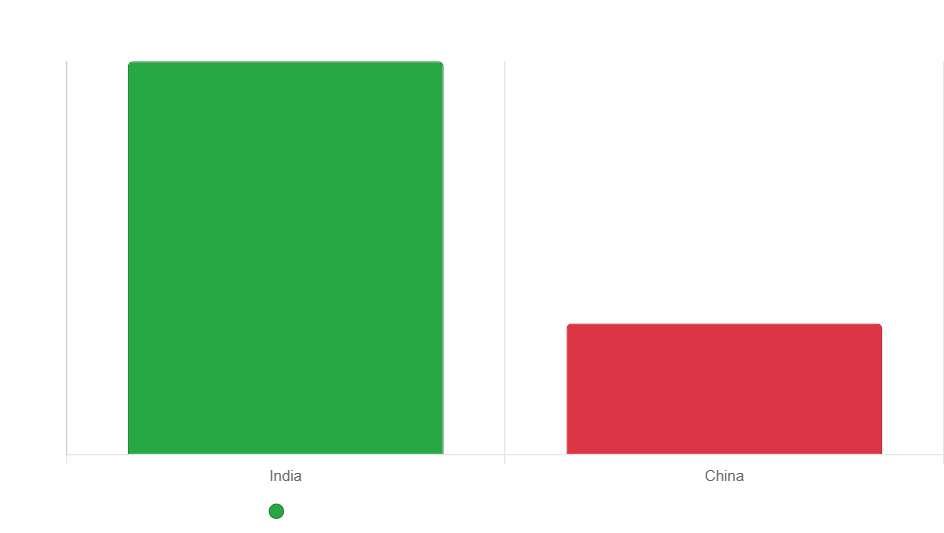
A groundbreaking report from TRG Datacenters has revealed a dramatic shift in the global AI landscape that few saw coming. India has surged to 6th place globally with 1.2 million H100 equivalents, while China has dropped to 7th position with only 400,000 H100 equivalents – meaning India now commands three times more AI computing power than its northern neighbor.
This stunning reversal marks a pivotal moment in the global technology race, with implications that extend far beyond mere numbers.
The New Global AI Power Rankings
According to the comprehensive TRG Datacenters analysis using the Epoch AI Supercomputers dataset, the top 10 AI powerhouses for 2025 are:
🥇 USA: 39.7M H100 equivalents
🥈 UAE: 23.1M H100 equivalents
🥉 Saudi Arabia: 7.2M H100 equivalents
4️⃣ South Korea: 5.1M H100 equivalents
5️⃣ France: 2.4M H100 equivalents
6️⃣ 🇮🇳 INDIA: 1.2M H100 equivalents
7️⃣ 🇨🇳 China: 400K H100 equivalents
8️⃣ UK: 120K H100 equivalents
9️⃣ Finland: 72K H100 equivalents
🔟 Germany: 51K H100 equivalents
To put India’s achievement in perspective, while still trailing the USA’s massive 39.7M H100 equivalents, India’s 1.2M represents just 3% of American capacity but 300% of China’s computing power. This positions India as a serious regional AI power with global implications, especially considering the USA’s investment spans decades while India’s surge represents recent strategic positioning.
Visual Comparison: India vs China AI Computing Power
India’s Strategic AI Advantage: Quality Over Quantity
India’s success story isn’t just about raw computing power. The country leads globally with 493,000 AI chips (ranking 3rd worldwide), powering 8 strategic clusters with 1.1 megawatts of capacity. This represents a quality-over-quantity approach that contrasts sharply with China’s infrastructure strategy.
While China operates 230 data center clusters worldwide – the most of any country – it generates only 289 megawatts of total power capacity. This sprawling approach appears less efficient than India’s concentrated, high-performance strategy.
The Numbers That Tell the Real Story
India’s AI Infrastructure:
- 493K AI chips (3rd globally)
- 8 strategic clusters
- 1.1K MW power capacity
- Quality-focused approach
China’s AI Infrastructure:
- 629K AI chips (2nd globally)
- 230 clusters (most worldwide)
- 289 MW power capacity
- Quantity-focused approach
The stark contrast reveals India’s 3.8x better power efficiency per cluster compared to China.
Indian Organizations Leading the AI Revolution
India’s remarkable AI surge is powered by a robust ecosystem of world-class organizations driving innovation across multiple sectors.
Government and Research Institutions
AIIMS Delhi has emerged as a healthcare AI leader. The government has selected AIIMS Delhi to spearhead India’s Center of Excellence in AI for healthcare, with a ₹330 crore grant under the Make AI in India initiative. AIIMS has partnered with IIT Delhi to establish a comprehensive AI research center focused on transforming healthcare delivery nationwide.
Indian Institutes of Technology (IITs) form the backbone of India’s AI research ecosystem:
- IIT Delhi leads the sustainable cities AI initiative, focusing on urban challenges like traffic management and energy efficiency
- IIT Kanpur spearheads agricultural AI applications, developing precision farming and crop management solutions
- IIT Ropar drives interdisciplinary AI research across multiple domains
- IIT Bombay’s C-MInDS (Centre for Machine Intelligence and Data Science) leverages strong interdisciplinary academic communities for AI innovation
- IIT Hyderabad operates India’s first NVIDIA AI Technology Centre (NVAITC) in partnership with NVIDIA
National Informatics Centre (NIC) has developed groundbreaking AI solutions: AI Panini provides text translation services in 22 official Indian languages, with specialized legal translation systems used by the Supreme Court of India. AI Saransh offers text summarization services currently deployed across 12 government projects.
Corporate AI Champions
Tata Consultancy Services (TCS) stands as India’s AI consulting giant. TCS has partnered with IIT Madras to launch an M.Tech program in Industrial AI, specifically designed for working professionals. The company has also established an AI-powered Research & Innovation Centre in Singapore and partnered with Google Cloud to accelerate AI-driven innovation in financial services.
Infosys has made significant AI infrastructure investments. The Infosys Centre for Artificial Intelligence at IIIT Delhi, established in 2016, conducts cutting-edge AI research while running specialized B.Tech and M.Tech programs. Infosys has released open-source AI tools including the Infosys Topaz Responsible AI Suite, designed to identify security risks, privacy violations, and biased AI outputs.
Reliance Industries is making massive AI infrastructure investments. The company announced construction of a 3 GW data center for AI services in Jamnagar in 2025, along with JioBrain, which includes over 500 REST APIs for natural language processing, image-to-video conversion, and enterprise-ready AI services.
Emerging AI Ecosystem
BharatGen Consortium represents India’s collaborative AI research approach. As of February 2025, the consortium includes 50-60 researchers from IIM Indore, IIIT Hyderabad, IIT Bombay, IIT Kanpur, IIT Hyderabad, IIT Mandi, and IIT Madras, working on AI models that incorporate India’s 1,600 languages and scripts.
Microsoft’s India Investment demonstrates international confidence in India’s AI potential. From 2025 to 2027, Microsoft plans to invest ₹25,000 crore (US$3.0 billion) in cloud and AI infrastructure development across India.
Ethical AI Leadership: India’s Responsible Approach
Beyond raw computing power, India is positioning itself as a leader in ethical AI development. The government announced creation of an IndiaAI Safety Institute in January 2025, focusing on ethical and safe AI applications grounded in India’s diverse social, economic, and cultural context.
This institute will promote research using Indian datasets while ensuring AI development remains transparent and unbiased. Key initiatives include watermarking and labeling systems, ethical AI frameworks, risk assessment tools, and deepfake detection capabilities.
Infosys has contributed significantly to responsible AI with its open-source Topaz Responsible AI Suite, designed to identify security risks, privacy violations, biased outputs, and harmful content in AI systems. This toolkit enhances transparency in AI decision-making while ensuring compliance with data protection regulations.
India’s approach contrasts with more centralized AI governance models, emphasizing democratic, collaborative frameworks that balance innovation with social responsibility.
What Drives India’s AI Success?
Strategic Focus on Efficiency
India’s approach prioritizes computing efficiency over infrastructure sprawl. While China builds numerous data centers, India concentrates on high-performance, strategically located facilities that deliver maximum computational output per facility.
World-Class Talent Pipeline
India’s renowned IIT system and technical universities produce globally competitive AI talent. This human capital advantage, combined with strong English proficiency, positions India as an attractive destination for international AI collaborations.
Government Policy Support
The Indian government announced creation of an IndiaAI Safety Institute in January 2025 to ensure ethical AI development grounded in India’s social, economic, and cultural diversity. The government has committed ₹990 crore over five years (2023-28) to establish AI Centers of Excellence under the “Make AI in India and Make AI Work for India” initiative.
Industry-Academia Collaboration
Unlike isolated development models, India emphasizes collaborative ecosystems where government institutions, private companies, and international partners work together on shared AI objectives.
The Workforce Challenge and Opportunity
Despite technological advances, only 0.1% of India’s workforce currently engages with AI – representing both a challenge and an enormous opportunity. In comparison, South Korea leads globally with nearly half its workforce using AI in some capacity.
This gap suggests massive untapped potential. As India accelerates workforce AI adoption through education and training programs, the country could see exponential productivity gains across all sectors.
Global Investment Context
Global AI infrastructure investment reached a record $200 billion in 2025 as nations compete for computational supremacy in what has become a geopolitical and economic race. India’s efficient approach to this investment – achieving more computing power per dollar spent than competitors – positions the country for sustained growth.
What This Means for the Global AI Race
Quality Trumps Quantity
India’s success demonstrates that strategic, efficient AI infrastructure outperforms massive but dispersed deployments. This lessons holds implications for other developing nations seeking AI leadership.
The Rise of AI Multipolarity
The emergence of multiple AI powers beyond the US-China duopoly suggests “a multipolar AI world” where countries like India, UAE, and South Korea play significant roles.
Workforce Development is Critical
Countries that combine AI infrastructure with comprehensive workforce training programs will likely outperform those focusing solely on hardware deployments.
Challenges Ahead for India
Scaling Workforce Adoption
India must dramatically increase AI workforce engagement from the current 0.1% to remain competitive with countries like South Korea (50% engagement). This represents both India’s greatest challenge and most significant opportunity.
Infrastructure Scalability Demands
While India’s efficient approach works well currently, maintaining technological leadership requires sustained investment in next-generation AI infrastructure. The country needs to expand from 8 current clusters to potentially dozens while maintaining power efficiency advantages.
Talent Pipeline Development
Despite strong technical universities, India faces growing demand for specialized AI talent. The country must accelerate training programs in machine learning, neural networks, and AI system design to support continued growth.
Energy Infrastructure Requirements
India’s 1.1K MW current capacity needs substantial expansion to support projected AI growth. Building sustainable, reliable power infrastructure for energy-intensive AI operations presents significant logistical challenges.
Regulatory Framework Development
Recent government cautions about using AI tools like ChatGPT for government work highlight the need for comprehensive AI governance frameworks that balance innovation with security concerns. India must develop policies that encourage innovation while protecting national interests.
The Road Ahead: India’s AI Vision 2030
India’s current 6th place ranking with 3x China’s computing power represents just the beginning. With strategic investments from organizations like Microsoft, Reliance, and TCS, combined with world-class research institutions and government support, India is positioned to challenge the top 5 AI powers.
Key Success Factors Moving Forward:
- Accelerated workforce AI adoption programs
- Continued infrastructure efficiency improvements
- International collaboration expansion
- Ethical AI development leadership
- Industry-academia partnership deepening
Conclusion: A New Chapter in Global AI Leadership
India’s dramatic surge past China in AI computing power marks more than a statistical milestone – it represents a fundamental shift in global technology leadership. By prioritizing efficiency over scale, collaboration over competition, and practical applications over theoretical research, India has created a sustainable model for AI development that other nations are beginning to study and emulate.
The implications extend beyond technology into geopolitics, economics, and social development. India’s success demonstrates that emerging economies can compete with established powers through strategic focus and efficient resource allocation.
As the battle for AI supremacy intensifies, India’s unique combination of technical talent, strategic investments, collaborative ecosystem, and ethical framework positions the country not just as a participant, but as a potential leader in shaping the AI-powered future.
Whether you’re a tech professional, policy maker, or simply curious about AI’s global impact, understanding India’s strategic approach offers valuable insights into successful AI development models.
For comprehensive AI insights, strategic guidance, and tools to navigate the rapidly evolving global AI landscape, visit vimalsingh.in. Stay ahead of AI trends with expert analysis and actionable strategies for the AI-powered future.
The question is no longer whether India will play a major role in global AI development, but how quickly other nations will adapt to India’s efficient, collaborative, and ethically-grounded approach to AI infrastructure and workforce development.
#IndiaAIRevolution #AIComputingPower #VimalSinghAI #GlobalAITrends #IndiaAI2025 #TechLeadership
Leave a Reply