Token-Oriented Object Notation is Revolutionizing AI Data Exchange
A Better Way to Send Data to AI Models
Still sending JSON to your AI models? You’re wasting tokens and money.
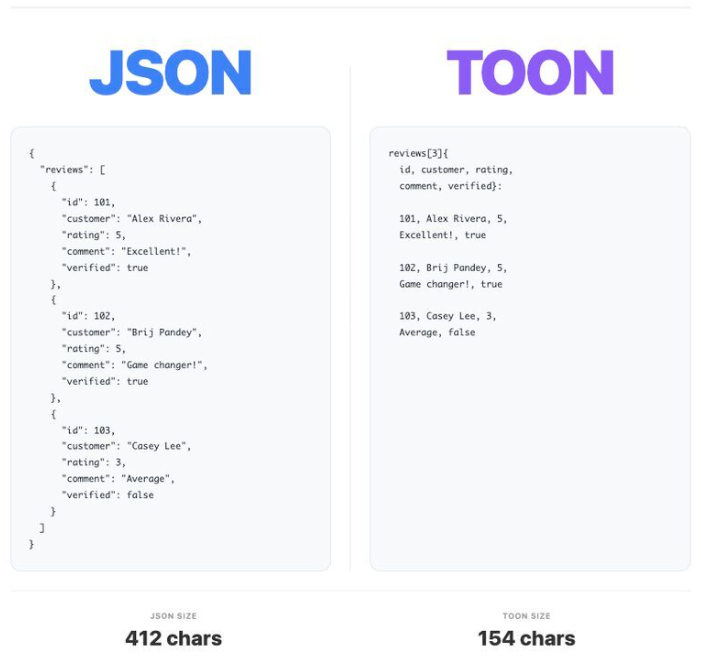
There’s a new format taking over the AI world. TOON (Token-Oriented Object Notation) just launched. It fixes what’s broken with JSON for AI systems.
Why does this matter? AI models charge you for every token. JSON wastes tokens with extra brackets and quotes. TOON cuts this waste by 60%.
The Numbers Are Clear
The same data needs 412 characters in JSON but only 154 characters in TOON. That’s 62% less.
This means:
Lower costs
Faster speeds
Less waiting
Better budgets
Why TOON Works Better
What Makes TOON Special:
Uses Fewer Tokens: 30-60% less than JSON for lists and tables Works Better: AI models read it more easily Clean Code: No extra brackets or quotes Easy Switch: Keep JSON in your app, use TOON for AI
Best Uses for TOON:
Data logs and trackingProduct lists and catalogsUser data and customersReports and analyticsAny repeated data structure
Stick with JSON when: You have complex nested data
Who Should Adopt TOON Right Now?
If you’re building any of these, TOON should be your new default:
AI Agents and Copilots
Automation systems and workflows
RAG (Retrieval-Augmented Generation) pipelines
Conversational AI platforms
Multi-agent frameworks
LLM-powered analytics tools
Implementation is Simple: Start Today
TOON has active implementations across multiple programming languages:
TypeScript/JavaScript: Official reference implementation
Python: Full encoder/decoder with CLI tools
PHP: Complete integration with popular AI libraries
Java: Maven Central available
Go & Rust: Community implementations available
Getting Started is Easy:
Keep your existing JSON infrastructure
Convert to TOON only when sending to LLMs
Measure your token savings immediately
Scale across your AI applications
The Bigger Picture: AI Data Optimization
We’ve spent years optimizing AI models for performance. Now it’s time to optimize the data we feed them.
TOON represents a fundamental shift in how we think about AI data exchange – moving from human-readable formats to LLM-optimized formats that speak the language of modern AI systems.
Real-World Impact:
Startup savings: Reduce LLM API costs by 30-60%
Enterprise scale: Massive savings across thousands of daily requests
Better performance: Faster inference with smaller payloads
Improved accuracy: LLMs parse structured data more reliably
Ready to Cut Your LLM Costs?
The early adopters are already seeing significant savings. TOON is gaining momentum fast in the AI community, with major frameworks beginning integration.
Don’t wait until your competitors are saving 60% on tokens while you’re still using verbose JSON.
Regulatory compliance issues with legal implications
Why Technical Skills Matter More Than Ever in Enterprise Development
Enterprise software development requires:
Systems thinking to understand complex interdependencies
Technical depth to navigate layered infrastructure
Risk assessment to prevent catastrophic failures
Compliance knowledge for regulatory requirements
Incident response skills for production emergencies
The Bottom Line: AI Tools vs Enterprise Reality
While AI can assist with code generation and simple tasks, enterprise development demands human expertise in:
Complex system architecture design
Cross-platform integration strategies
Risk mitigation and disaster recovery
Regulatory compliance implementation
Critical incident resolution
Enterprise IT isn’t going anywhere. The complexity, compliance requirements, and high-stakes nature of Fortune 500 systems will continue to require skilled developers who understand the full scope of enterprise software development.
How many times have you shouted this at a chatbot? I’ve done it more times than I want to admit.
In my work, I also get to switch sides and look at the teams providing these systems, or sit with the engineering team behind them.
Usually, to them, everything looks fine. The AI performance metrics look good. The dashboards are clean. Everyone feels quietly confident that things are “good enough.”
But the moment you look at actual outcomes – real customer satisfaction, real escalations, real decision quality, you realise something is clearly not working the way people assume it is.
And honestly, after seeing this across so many companies, the pattern is impossible to ignore.
The model is almost never the real problem.
I keep running into the same three issues again and again:
𝟏. 𝐃𝐚𝐭𝐚 𝐈𝐧𝐭𝐞𝐠𝐫𝐢𝐭𝐲 Teams argue about definitions that should be obvious, and the model ends up learning from contradictory truths.
𝟐. 𝐃𝐞𝐜𝐢𝐬𝐢𝐨𝐧 𝐂𝐥𝐚𝐫𝐢𝐭𝐲 Ask three people how a decision is made today and you’ll get five answers. AI learns those contradictory, unwritten rules… inconsistently.
𝟑. 𝐄𝐯𝐚𝐥𝐮𝐚𝐭𝐢𝐨𝐧 𝐀𝐫𝐜𝐡𝐢𝐭𝐞𝐜𝐭𝐮𝐫𝐞 Everybody checks the model before launch. Nobody checks it after. So drift quietly creeps in until customers are the first to notice.
𝐓𝐡𝐢𝐬 𝐢𝐬 𝐭𝐡𝐞 𝐡𝐢𝐝𝐝𝐞𝐧 𝐜𝐨𝐬𝐭 𝐨𝐟 “𝐠𝐨𝐨𝐝 𝐞𝐧𝐨𝐮𝐠𝐡” 𝐀𝐈.
It behaves well in the metrics… and badly in the real world.
I wrote about this in my latest Substack because these problems are fixable, but only if you stop looking at your dashboards and start examining your foundations.
If you’ve ever felt like your AI is “mostly fine” but your customers are telling a different story… you’ll relate to it.
Here’s how AI-Powered Agents can Automate the entire Competitive Intelligence process, from collecting signals to delivering insights:
𝟏. 𝐏𝐮𝐬𝐡 𝐔𝐩𝐝𝐚𝐭𝐞𝐬 𝐟𝐫𝐨𝐦 𝐒𝐨𝐮𝐫𝐜𝐞𝐬: Monitor diverse sources like news, press, competitors, and social media for real-time updates. These updates are sent to an event bus (SNS, SQS, Kafka) or a webhook queue.
𝟐. 𝐏𝐫𝐨𝐜𝐞𝐬𝐬𝐢𝐧𝐠 𝐓𝐢𝐞𝐫𝐬: Classify updates based on priority focusing on high-priority sources like pricing, launches, and funding. Medium-priority updates include blogs and case studies, while low-priority updates focus on reviews and trends.
𝟑. 𝐒𝐢𝐠𝐧𝐚𝐥 𝐂𝐨𝐥𝐥𝐞𝐜𝐭𝐨𝐫 𝐀𝐠𝐞𝐧𝐭: Aggregates, filters, deduplicates, and enriches signals by adding metadata, reducing noise by up to 90%.
𝟒. 𝐈𝐧𝐭𝐞𝐥𝐥𝐢𝐠𝐞𝐧𝐜𝐞 𝐀𝐧𝐚𝐥𝐲𝐬𝐭 𝐀𝐠𝐞𝐧𝐭: Retrieves competitor history and contextualizes each signal, categorizing it by urgency, impact, and relevance. This agent looks for patterns in competitor behavior.
𝟓. 𝐂𝐨𝐧𝐭𝐞𝐧𝐭 𝐒𝐭𝐫𝐚𝐭𝐞𝐠𝐢𝐬𝐭 𝐀𝐠𝐞𝐧𝐭: Generates draft updates, suggests objection handlers, and creates win/loss matrices. It pulls insights from CRM data and produces content for reports or battle cards.
𝟔. 𝐎𝐩𝐩𝐨𝐫𝐭𝐮𝐧𝐢𝐭𝐲 𝐒𝐜𝐨𝐮𝐭 𝐀𝐠𝐞𝐧𝐭: Monitors competitor activities, identifies opportunities, and surfaces vulnerabilities. It matches competitor movements with your sales pipeline to suggest talking points for sales teams.
𝟕. 𝐇𝐮𝐦𝐚𝐧-𝐢𝐧-𝐭𝐡𝐞-𝐋𝐨𝐨𝐩: Provides oversight, ensuring AI-driven insights are validated and approved before use.
𝟖. 𝐌𝐨𝐝𝐞𝐥 𝐈𝐧𝐟𝐞𝐫𝐞𝐧𝐜𝐞 𝐋𝐚𝐲𝐞𝐫 AI models (like Amazon Bedrock, GPT, and Claude) analyze and enhance the intelligence gathered by agents.
𝟗. 𝐌𝐞𝐦𝐨𝐫𝐲 𝐚𝐧𝐝 𝐀𝐧𝐚𝐥𝐲𝐭𝐢𝐜𝐬: Store insights and historical data in systems like Redis, Upstash, and Amazon S3. Use analytics tools like Google Analytics and Mixpanel to measure usage and performance.
This is Agnetic AI at its best automating data collection, signal filtering, analysis, and decision-making processes for more efficient competitive tracking.
Is your organization ready to move from manual competitive analysis to intelligent automation?
The shocking truth about how biased job postings are costing you top talent
43% of top candidates end up in the rejected folder due to bias
The Hidden Bias Crisis
Think your job postings are neutral? Think again. Your last job posting contained 14 bias indicators that are silently pushing away qualified candidates before they even apply.
73%
of diverse candidates skip biased job posts
2.3x
longer time-to-hire with biased language
$15K
average cost per mis-hire due to bias
Your Job Posting’s Hidden Bias Indicators
“Aggressive”Gender Biased
“Recent Graduate”Age Biased
“Culture-Fit”Diversity Eliminator
“Top College”Socioeconomic Bias
“Young & Dynamic”Age Discrimination
“Native Speaker”Language/Origin Bias
The Real Cost of Biased Hiring
When your job descriptions contain unconscious bias, you’re not just missing out on talent—you’re actively creating barriers that prevent the best candidates from even applying. Studies show that:
Women are 32% less likely to apply to jobs with masculine-coded language
Older workers skip 67% of age-biased postings
Diverse candidates self-eliminate when they see “culture fit” requirements
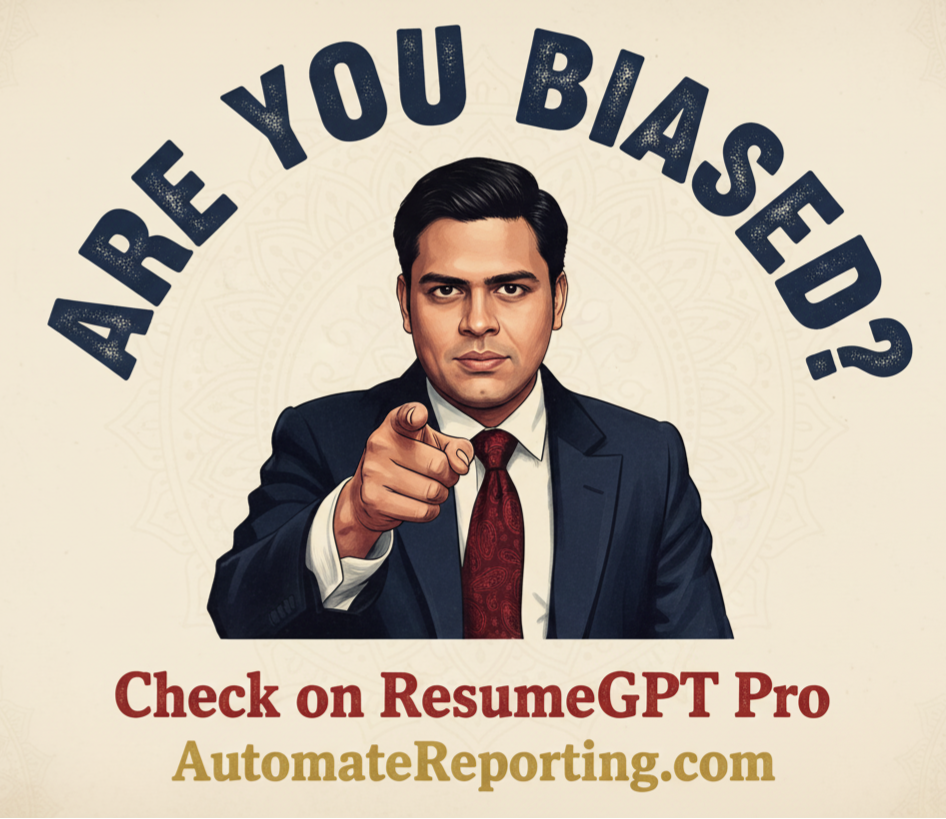
🎯 Check Your Conscious Bias with ResumeGPTPro
Our AI-powered bias detection scans your job postings in real-time, identifying problematic language and suggesting inclusive alternatives.Scan Your Job Posting for FREE
The Path to Bias-Free Hiring
Equal hiring isn’t just about compliance—it’s about finding the best talent regardless of background. When you eliminate bias from your recruitment process, you:
Access 2.3x larger talent pools
Reduce time-to-hire by 40%
Improve team performance by 35%
Build stronger, more innovative teams
Take Action Today
Don’t let unconscious bias cost you another great hire. Start by auditing your current job postings and identifying language that might be turning away qualified candidates.
Remember: True diversity starts with inclusive language. Every word matters when you’re trying to build the best team possible.
8 non-robotics experts had to program quadruped robots to fetch beach balls.
The real bottleneck was connecting to unfamiliar hardware.
Team Claude navigated sensor integration nightmares and conflicting Stack Overflow answers efficiently.
Team Claude-less spent HOURS stuck on basic connections, not because they couldn’t code, but because they hit the documentation wall.
𝐖𝐨𝐫𝐤 𝐩𝐚𝐭𝐭𝐞𝐫𝐧𝐬 𝐬𝐡𝐢𝐟𝐭𝐞𝐝 𝐜𝐨𝐦𝐩𝐥𝐞𝐭𝐞𝐥𝐲:
Team Claude-less → 44% more questions to each other, more collaboration, shared suffering
Team Claude → each person paired with AI, explored in parallel, built side projects (like a natural language controller for robot push-ups)
𝐎𝐧𝐞 𝐦𝐞𝐦𝐨𝐫𝐚𝐛𝐥𝐞 𝐦𝐨𝐦𝐞𝐧𝐭: Team Claude programmed their robot to move 1 m/s for 5 seconds. Classic human math error, they were less than 5 meters from the other team’s table.
Robot charged. Emergency power-off. No injuries. Morale destroyed.
𝐖𝐡𝐲 𝐭𝐡𝐢𝐬 𝐦𝐚𝐭𝐭𝐞𝐫𝐬 𝐟𝐨𝐫 𝐞𝐧𝐭𝐞𝐫𝐩𝐫𝐢𝐬𝐞 𝐀𝐈: The hardest part of AI-physical integration isn’t the AI itself. It’s connecting to unknown systems with messy documentation. As models improve, this bottleneck shrinks fast.
Anthropic now tracks this as a capability threshold in their Responsible Scaling Policy.
→ Today: AI helps humans connect to unfamiliar hardware → Tomorrow: AI connects autonomously to unknown systems → No 6-month integration cycles
This is beyond robot dogs fetching balls. It’s about AI bridging digital-physical divides at enterprise scale.
𝐅𝐮𝐧𝐜𝐭𝐢𝐨𝐧 𝐂𝐚𝐥𝐥𝐢𝐧𝐠 = 𝐒𝐩𝐞𝐞𝐝 𝐃𝐢𝐚𝐥 LLM picks function → API responds → Done.
Perfect for: Known tasks, trusted environments, moving fast.
Note – LLM has direct access to your APIs. No bouncer at the door.
𝐌𝐂𝐏 = 𝐂𝐡𝐞𝐜𝐤𝐩𝐨𝐢𝐧𝐭 𝐒𝐲𝐬𝐭𝐞𝐦 Client evaluates → Routes through validation layer → Server picks tool → You control what happens.
Perfect for: Enterprise environments, but design with caution.
Note – It adds complexity. And “safety” isn’t automatic – it’s just possible.
𝐌𝐂𝐏 𝐢𝐬𝐧’𝐭 𝐦𝐚𝐠𝐢𝐜𝐚𝐥𝐥𝐲 𝐬𝐚𝐟𝐞. It’s a framework that gives you: – Interception points (so you can validate requests) – Server-side control (so you decide what’s exposed) – Separation of concerns (so one bad call doesn’t nuke everything)
You still have to write the validation logic, define access controls, build the guardrails.
𝐖𝐡𝐞𝐧 𝐭𝐨 𝐮𝐬𝐞 𝐞𝐚𝐜𝐡? Function Calling: Prototyping, internal tools, 1-2 predictable functions, you trust the LLM’s judgment.
MCP: Production systems, multiple tools, compliance requirements, you need audit trails, things break if the AI guesses wrong.
Function calling is fast and simple until you scale. MCP is structured and controllable – but only if you actually build the controls.
Choose based on what happens when things go wrong, not when they go right.
Screens resumes without grasping cultural name variations
Penalizes career gaps common in certain communities
Misunderstands educational systems from different countries
The pattern is clear: Technical brilliance without cultural intelligence creates systematic exclusion.
What Are Cultural Artifacts in AI?
Every AI output carries invisible cultural DNA.
Language Models Reflect Worldviews
Consider these AI-generated responses:
Question: “What makes a good leader?”
Typical AI Response: “Good leaders are decisive, confident, and results-oriented.”
Cultural Blind Spot: This reflects Western, individualistic leadership ideals. Many cultures value consensus-building, humility, and relationship-focused leadership.
Recommendation Systems Encode Preferences
Netflix’s Algorithm:
Trained on viewing patterns from specific demographics
Reinforces existing content preferences
Misses cultural storytelling traditions not represented in training data
Result: Global audiences receive recommendations based on narrow cultural assumptions.
The Alan Turing Institute’s Solution: Interpretive AI
The Alan Turing Institute is pioneering a new approach: Interpretive AI.
Core Principles:
Embrace ambiguity instead of eliminating it
Honor context rather than ignoring it
Work with humans, not around them
Question assumptions, not just optimize metrics
Professor Hemment’s Warning
“We have a narrowing window to build interpretive capabilities from the ground up.”
Translation: We’re rapidly scaling AI systems built on narrow foundations. The longer we wait to integrate cultural intelligence, the harder it becomes to fix.
How Historians Shape AI Development
Historians bring critical skills AI development desperately needs.
Pattern Recognition Across Time
What historians do:
Identify recurring patterns in human behavior
Understand how context shapes events
Recognize when current situations echo past dynamics
How this helps AI:
Better prediction of human responses to technological change
Understanding of cultural resistance patterns
Recognition of historical biases embedded in data
Example: Historical Context in Financial AI
The Problem: AI credit scoring systems penalize applicants from historically redlined neighborhoods.
Historian’s Insight: These patterns reflect deliberate exclusion policies, not inherent risk factors.
Better AI: Incorporates historical context to identify and correct systematic bias rather than perpetuating it.
How Anthropologists Transform AI
Anthropologists understand culture as a living, breathing system.
Deep Cultural Pattern Recognition
Anthropological Skills:
Participant observation reveals hidden cultural rules
Cross-cultural comparison identifies universal vs. specific patterns
Ethnographic methods uncover unspoken assumptions
AI Applications:
Design systems that adapt to local cultural contexts
Identify biases invisible to technical teams
Create culturally sensitive user interfaces
Example: Anthropology in Social Media AI
The Challenge: Content moderation AI struggles with context-dependent communication.
Anthropological Solution:
Map cultural communication patterns
Understand humor, sarcasm, and social dynamics
Design moderation that considers cultural context
Result: More nuanced, fair content policies.
The Current State: Monoculture AI
Most AI development happens in narrow geographic and cultural bubbles.
Geographic Concentration
AI Development Centers:
Silicon Valley: 40% of AI research
Beijing: 25% of AI patents
London: 15% of AI startups
Cultural Homogeneity:
Similar educational backgrounds
Shared cultural assumptions
Limited global perspective
Data Diet Problems
Training Data Sources:
English-language content: 60% of training data
Western cultural contexts dominate
Underrepresented communities provide minimal input
Result: AI systems that work well for some, poorly for others.
Building Interpretive AI: Practical Steps
1. Diverse Team Composition
Traditional AI Team:
Computer scientists
Data engineers
Machine learning researchers
Interpretive AI Team:
Anthropologists for cultural context
Historians for temporal perspective
Linguists for communication nuance
Sociologists for social dynamics
Local community representatives
2. Cultural Context Integration
Technical Implementation:
Multi-cultural training datasets
Context-aware algorithms
Regional adaptation capabilities
Community feedback loops
Example: Google Translate’s improvement when linguists joined development teams to understand cultural idioms and context.
3. Interpretive Design Principles
Question-Driven Development:
“Whose perspective does this serve?”
“What stories might this erase?”
“How does cultural context change meaning?”
“What assumptions are we embedding?”
Real-World Success Stories
Microsoft’s Inclusive AI Initiative
Approach: Partnered with anthropologists to study global communication patterns.
Implementation:
Cultural consultants for each major market
Local testing with community groups
Iterative design based on cultural feedback
Result: 40% improvement in cross-cultural user satisfaction.
IBM Watson’s Healthcare Evolution
Original Problem: Watson recommended treatments based on narrow medical datasets.
Anthropological Input:
Studied cultural expressions of illness
Mapped traditional healing practices
Understood patient-doctor communication patterns
Improved Outcome: Better diagnostic accuracy across diverse populations.
The Economic Case for Interpretive AI
Cultural intelligence isn’t just ethical—it’s profitable.
Market Expansion
Companies with culturally intelligent AI:
Access broader global markets
Reduce customer churn from cultural misunderstandings
Build stronger brand loyalty through inclusive design
Risk Reduction
Cultural blind spots create business risks:
Regulatory penalties for biased algorithms
Public relations disasters from cultural insensitivity
Lost revenue from excluded user groups
Innovation Acceleration
Diverse perspectives drive innovation:
Novel solutions from different cultural approaches
Breakthrough insights from cross-cultural collaboration
Faster problem-solving through varied mental models
Challenges and Barriers
Technical Resistance
Common Objections:
“Cultural context slows development”
“Interpretive approaches are too subjective”
“We need scalable, not customizable solutions”
Counter-Arguments:
Cultural context prevents expensive fixes later
Subjectivity reflects human reality
Customization enables true scalability
Resource Constraints
Investment Requirements:
Hiring diverse expertise
Longer development timelines
Complex testing across cultures
Return on Investment:
Reduced bias-related lawsuits
Expanded market reach
Improved user engagement
The Future of Human-AI Collaboration
Interpretive AI represents a fundamental shift in how we think about artificial intelligence.
From Automation to Augmentation
Old Model: AI replaces human judgment New Model: AI enhances human understanding
From Efficiency to Effectiveness
Old Focus: Faster, cheaper, more automated New Focus: More inclusive, contextual, culturally intelligent
From Universal to Adaptive
Old Approach: One-size-fits-all solutions New Approach: Context-aware, culturally responsive systems
Practical Recommendations for Organizations
Immediate Actions (Next 30 Days):
Audit Current AI Systems:
Identify cultural assumptions in existing models
Map user diversity across different regions
Assess feedback patterns from underrepresented groups
Build Diverse Teams:
Recruit humanities scholars for AI projects
Establish cultural advisory boards
Create cross-functional collaboration processes
Strategic Planning (Next 6 Months):
Implement Interpretive Design:
Develop cultural context frameworks
Create community testing protocols
Establish bias detection and correction processes
Investment in Education:
Train technical teams in cultural competency
Educate humanities scholars in AI basics
Foster cross-disciplinary collaboration skills
Long-term Vision (1-3 Years):
Build Interpretive Capabilities:
Develop culturally adaptive AI architectures
Create global testing and feedback networks
Establish interpretive AI as competitive advantage
The Urgency of Now
Professor Hemment’s warning echoes throughout the industry: We have a narrowing window.
Why the urgency?
AI systems become harder to change as they scale
Cultural biases compound over time
Early design decisions create long-term lock-in effects
The window is closing for building interpretive capabilities from the ground up.
What This Means for Different Stakeholders
For AI Developers:
Learn basic anthropology and historical thinking
Question cultural assumptions in your work
Seek diverse perspectives throughout development
For Humanities Scholars:
Engage with AI development teams
Translate cultural insights into technical requirements
Bridge the gap between interpretation and implementation
For Organizations:
Invest in diverse AI development teams
Prioritize cultural intelligence alongside technical capability
View interpretive AI as competitive advantage
For Policymakers:
Require cultural impact assessments for AI systems
Fund interdisciplinary AI research
Support inclusive AI development standards
The Bottom Line: Better Questions, Not Just Better Code
The future of AI won’t be saved by better algorithms. It’ll be shaped by better questions.
Questions historians ask:
“How has this pattern played out before?”
“What voices are missing from this narrative?”
“How does context change meaning?”
Questions anthropologists ask:
“Whose cultural framework does this assume?”
“How do different communities interpret this?”
“What invisible rules are we encoding?”
These questions matter because AI systems aren’t neutral tools. They’re cultural artifacts that reflect the assumptions of their creators.
The Path Forward: Humanities as Co-Builders
The old model: Humanities scholars as critics, pointing out problems after AI is built.
The new model: Humanities scholars as co-builders, shaping AI from the beginning.
This isn’t about slowing down AI development. It’s about building AI that actually works for everyone.
Because when we ignore cultural context:
Medical AI misdiagnoses across communities
Educational AI reinforces existing inequalities
Economic AI perpetuates historical biases
But when we embrace interpretive AI:
Systems adapt to local contexts
Technology enhances rather than erases cultural diversity
AI becomes truly intelligent—not just computationally powerful
Conclusion: The Humanities Imperative
AI outputs are cultural artifacts. They carry stories, assumptions, and worldviews.
The question isn’t whether historians and anthropologists can shape AI development.
The question is whether we’ll include them before it’s too late.
Because the future of AI isn’t just about processing power or algorithmic efficiency.
It’s about creating technology that honors the full complexity of human experience.
And that requires more than engineers and data scientists.
It requires storytellers. Pattern-readers. Cultural interpreters.
It requires the humanities.
The window is narrowing. But it’s still open.
The choice is ours.
About the Author: Vimal Singh explores the intersection of technology and human culture at vimalsingh.in. Connect for insights on interpretive AI and inclusive technology development.
NVIDIA GPUs became the new oil through technical excellence and ecosystem lock-in.
But unlike oil, computational resources can be democratized through innovation.
Key takeaways:
Technical advantages create geopolitical leverage
Platform diversity reduces strategic risk
Development choices today shape future options
Computational infrastructure is national security
The question isn’t whether NVIDIA will maintain dominance. The question is whether organizations will prepare for a multi-platform future.
Your development choices today determine your competitive options tomorrow.
The new oil economy is here. But unlike traditional resources, this one can be replicated, optimized, and democratized.
The organizations that recognize this will own the future.
About the Author: Vimal Singh analyzes the intersection of technology and geopolitics at vimalsingh.in. Connect for insights on tech strategy and global innovation trends.