Author: host

  • A Practical Guide to Building AI Agents for HR: OpenAI’s Blueprint for Workforce Transformation

    What Are AI Agents for HR, Really?

    Imagine a system that doesn’t just answer your question—it flags an employee at risk of attrition, drafts the manager notification, triggers an action plan, and updates the HRMS.

    That’s not a feature. That’s an HR AI agent.

    AI Agents for human resources are intelligent workflow executors. They’re powered by Large Language Models (LLMs), connected to tools, guided by goals—and increasingly, present in your HR meetings.

    If HR still thinks this is “someone else’s transformation,” it may be the last memo they miss.


    What OpenAI’s AI Agents Guide Really Says (for Real HR Workflows)

    Link – https://cdn.openai.com/business-guides-and-resources/a-practical-guide-to-building-agents.pdf

    AI Agents in HR are not experiments. They’re becoming best practice. Here’s what the guide clarifies:

    Agents handle complexity where rule-based systems fail Think of processes like workforce forecasting, sentiment analysis, or policy interpretation.

    Three things every HR AI agent needs

    • A Model (GPT-4o, for instance) to reason
    • Tools (APIs, databases, HRMS connectors) to act
    • Instructions (clear objectives) to execute

    Orchestration is a journey You don’t start with a swarm of agents. You start with one that handles one HR automation task better than a human ever could—and build from there.

    Guardrails are non-negotiable OpenAI is firm: build in safety, bias checks, and ethical layers. Not just for legal protection—but for trust.

    Start small. Validate. Expand. A good agent doesn’t need fanfare. It needs data, direction, and a clear job to do.

    Why HR Can’t Sit Out the AI Agent Revolution

    Because the AI agents for workforce management aren’t coming for HR. They’re already inside the firewall.

    In companies that have begun the shift, HR tasks like:

    • Generating automated HR reports
    • Predicting employee attrition
    • Processing grievances
    • Flagging burnout risks
    • Personalizing employee engagement plans

    are no longer handled by teams. They’re handled by intelligent HR agents—working 24/7, across geographies, without dashboards or reminders.

    The result isn’t fewer HR people. It’s HR people doing less admin and more actual human strategy.

    The HR AI Agent by AutomateReporting

    We didn’t wait for theory. We built the agent.

    AutomateReporting’s HR AI Agent


    • Focused on workforce insights, retention analytics, and automated reporting

    What it does:

    • Predicts attrition with up to 95 percent confidence
    • Segments risk by grade, function, tenure, and geography
    • Automates narrative reports—no Excel, no slides
    • Accepts natural language queries from business users

    It doesn’t do HR’s job. It gives HR the space to do it better.

    https://automatereporting.com


    The Future of HR: From Manual to Automated Intelligence

    Final Thought

    OpenAI gave us the blueprint for AI agents. But blueprints don’t build outcomes.

    You don’t need to hire 10 data scientists. You don’t need to rebuild your tech stack.

    You need one problem worth solving. One HR AI agent worth deploying.

    And the courage to ask:

    What else are we still doing manually that an AI agent could do… better, faster, and now?

    Ready to implement AI agents in your HR workflow? The technology exists. The blueprint is public. The only question is whether you’ll lead the transformation or watch from the sidelines.

  • What Are AI Agents? And Why They’re Not Just Fancy Chatbots

    What Are AI Agents? And Why They’re Not Just Fancy Chatbots

    What is an AI Agent?

    An AI agent is a software system that can autonomously perceive inputs, reason through options, take actions, and improve its behavior over time — all in service of achieving a specific goal.

    Unlike traditional programs or assistants, AI agents are proactive and goal-driven. They:

    • Interpret user intent,
    • Break down complex tasks,
    • Use external tools (e.g., APIs, databases),
    • Execute sequences of actions, and
    • Learn from outcomes to optimize performance.

    In short, they don’t just answer questions. They solve problems. Continuously, intelligently, and often independently.


    AI Agent vs. Assistant vs. Bot: A Clear Distinction

    FeatureAI AgentAI AssistantBot
    PurposeAutonomously and proactively perform tasksAssist users with tasksAutomate simple tasks or conversations
    CapabilitiesHandles complex, multi-step actions; learns, adaptsResponds to prompts, provides helpFollows pre-defined rules; limited interactions
    InteractionProactive; goal-drivenReactive; user-ledReactive; rule-based
    AutonomyHigh — acts independently to achieve goalsMedium — assists but relies on user directionLow — operates on pre-programmed logic
    LearningEmploys machine learning to adapt over timeSome adaptive featuresUsually static; no learning capability
    ComplexityHigh — solves enterprise-grade problemsMedium — supports workflowsLow — designed for repetitive tasks

    Most people still confuse assistants with agents. But think of it this way:

    • A bot asks, “How can I help you?”
    • An assistant says, “Here’s how I can help.”
    • An agent just gets it done — often before you even ask.

    How Do AI Agents Actually Work?

    AI agents follow a dynamic loop that mimics high-functioning human workflows:

    1. Perception

    They take in prompts or triggers (text, voice, system events) and understand them using natural language processing and contextual analysis.

    2. Planning

    Based on your intent, they break down tasks and decide what to do, which tools to use, and in what sequence.

    3. Execution

    They perform actions — calling APIs, writing emails, scraping data, querying databases, updating spreadsheets — whatever it takes.

    4. Observation

    Agents track the outcome of each action and adjust their next step accordingly.

    5. Learning

    Over time, agents evolve. They analyze feedback and improve how they work — just like a new hire becoming a top performer.


    So Why Is This a Big Deal?

    Because it changes what software means.

    For the first time, we don’t need to use tools. We can hire them.

    And in the next post, we’ll explore exactly how agents “think” — and how two major agent paradigms, ReAct and ReWOO, are shaping the future of autonomous systems.


    📌 Stay tuned: Next up — ReAct vs. ReWOO: How AI Agents Actually Think

  • IBM Just Fired 8,000 Employees.

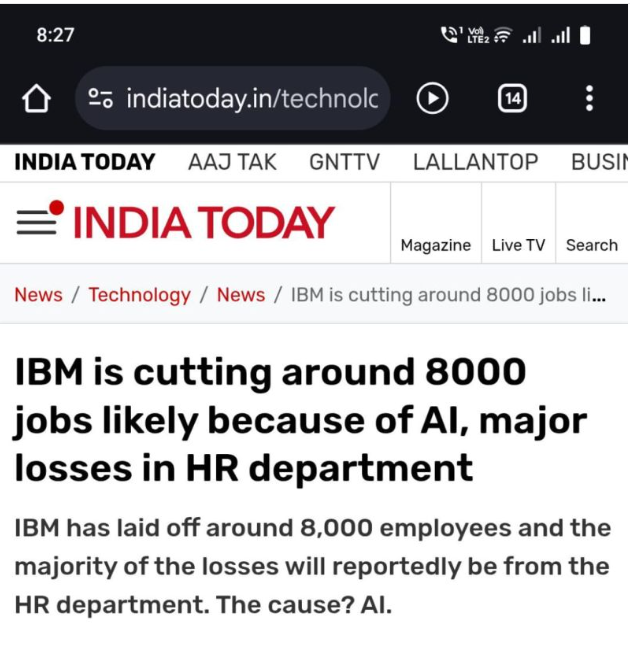
    IBM Just Fired 8,000 Employees.

    Most of Them from HR. The Reason? Not What You Think.
    No performance issues. No budget crisis. No media storm.
    Just progress—of the silent, algorithmic kind.
    Earlier this month, IBM let go of over 200 HR professionals in one quiet, clinical move. Replaced not by consultants, not by outsourcing, but by AI agents.
    Then it escalated.
    Over 8,000 roles were eliminated. The majority from HR. No scandal. No warning signs. Just efficiency, at scale.
    Resume screening? Automated. Employee queries? Chatbots. Onboarding, transfers, paperwork? One-click workflows.
    Tasks that once needed teams now require templates.
    This Isn’t Just a Corporate Layoff – It’s the Future of HR Automation
    This Isn’t Just a Layoff.
    It’s a Recalibration of What Work Means in HR.
    The message, if you’re listening, is brutally clear:
    If your work is repetitive, it’s replaceable. If your process isn’t evolving, it’s disappearing.
    And here’s what most news pieces missed: IBM isn’t shrinking. They’re growing.
    Their total headcount is on the rise.
    But while the quantity of employees is up, the quality of roles has shifted. Fewer administrators. More creators. Fewer processors. More problem-solvers.
    They’re not cutting back—they’re reallocating human intelligence toward functions where it actually matters.
    Software. Marketing. Sales. Product development.
    In other words, where AI assists—not replaces.
    The Hard Truth About AI in Human Resources
    HR Needs to Ask a Hard Question:
    Are we building the future—or just reacting to it?
    Because here’s what AI automation in HR doesn’t do:
    • It doesn’t take sick leaves.
    • It doesn’t burn out.
    • It doesn’t delay feedback or misplace a form.
    It’s fast. It’s accurate. And it’s tireless.
    So if your daily work looks like:
    • Copy-pasting data,
    • Chasing approvals,
    • Emailing reminders,
    • Generating reports from Excel—
    Then the truth is uncomfortable: AI isn’t coming. It’s already here.
    And it doesn’t want your badge. It wants your workflow.
    How HR Professionals Can Survive the AI Revolution
    But There’s Still a Way Forward.
    AI won’t kill HR. But HR that refuses to evolve? That’s a different story.
    There’s a new version of HR being born. One that:
    • Designs smarter org structures.
    • Builds predictive models for attrition.
    • Uses AI to personalize employee experience at scale.
    • Partners with technology—not competes with it.
    The IBM layoffs 2025 weren’t just a corporate cost-cutting move. It was a mirror held up to the industry.
    The reflection? Not flattering.
    The Future of Work: Adapt or Be Automated
    Final Thought:
    AI won’t take your job. But someone using AI will.
    The question is: Will you be the one who gets replaced—or the one who builds what comes next?
    ________________________________________
    Are you preparing for the AI transformation in HR? The signs are everywhere. The choice is yours: evolve with technology or risk being left behind.
    Share your thoughts: How is AI already changing your HR work? What skills are you developing to stay relevant?
    ________________________________________

  • “You can’t predict Employee attrition like that.”

    The CHRO said it flatly. Not as a challenge. As a truth of the HR universe. The kind uttered after decades of battling dashboards, gut feel, and last-minute exit interviews.

    I didn’t respond. Just opened my laptop.

    “Watch.”

    He leaned forward. I hit run. Five seconds. The screen blinked.

    A clean report emerged. Not a dashboard. A verdict.

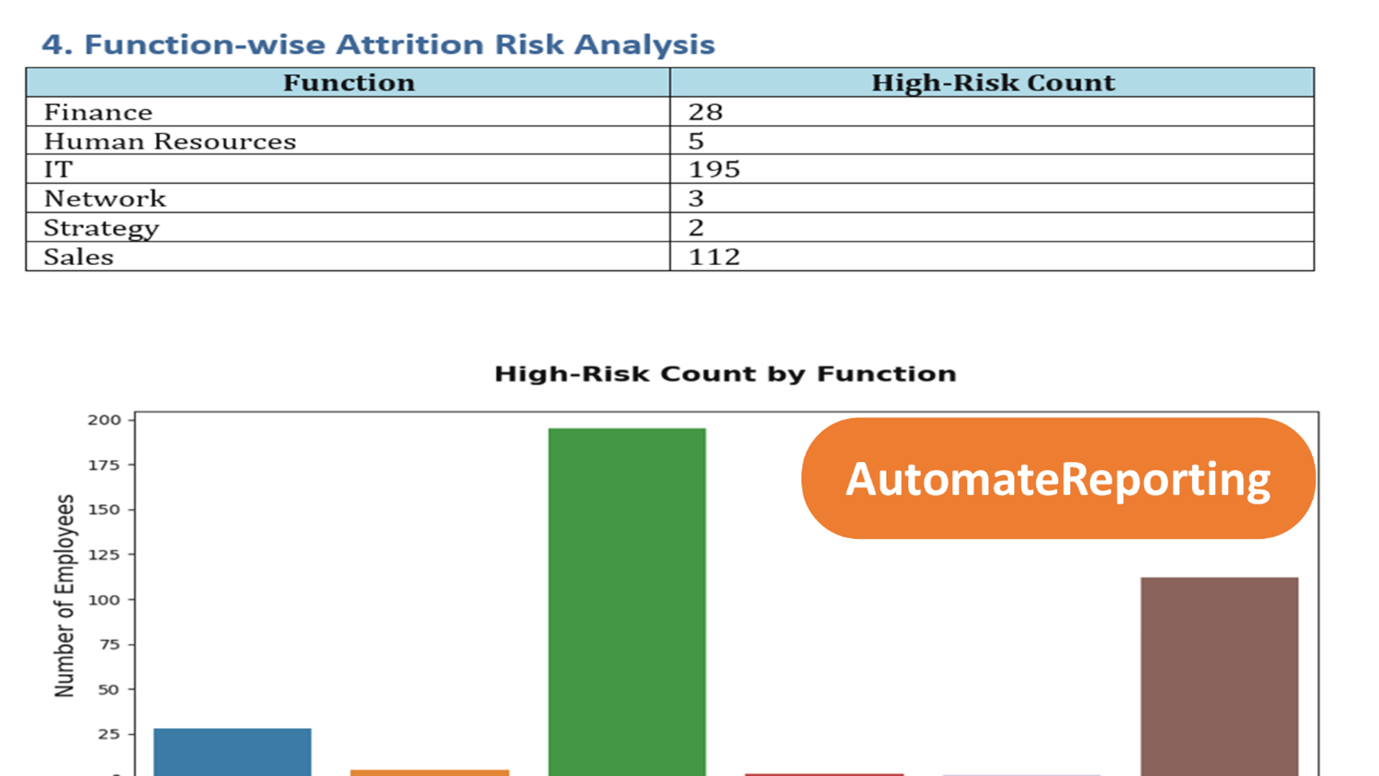
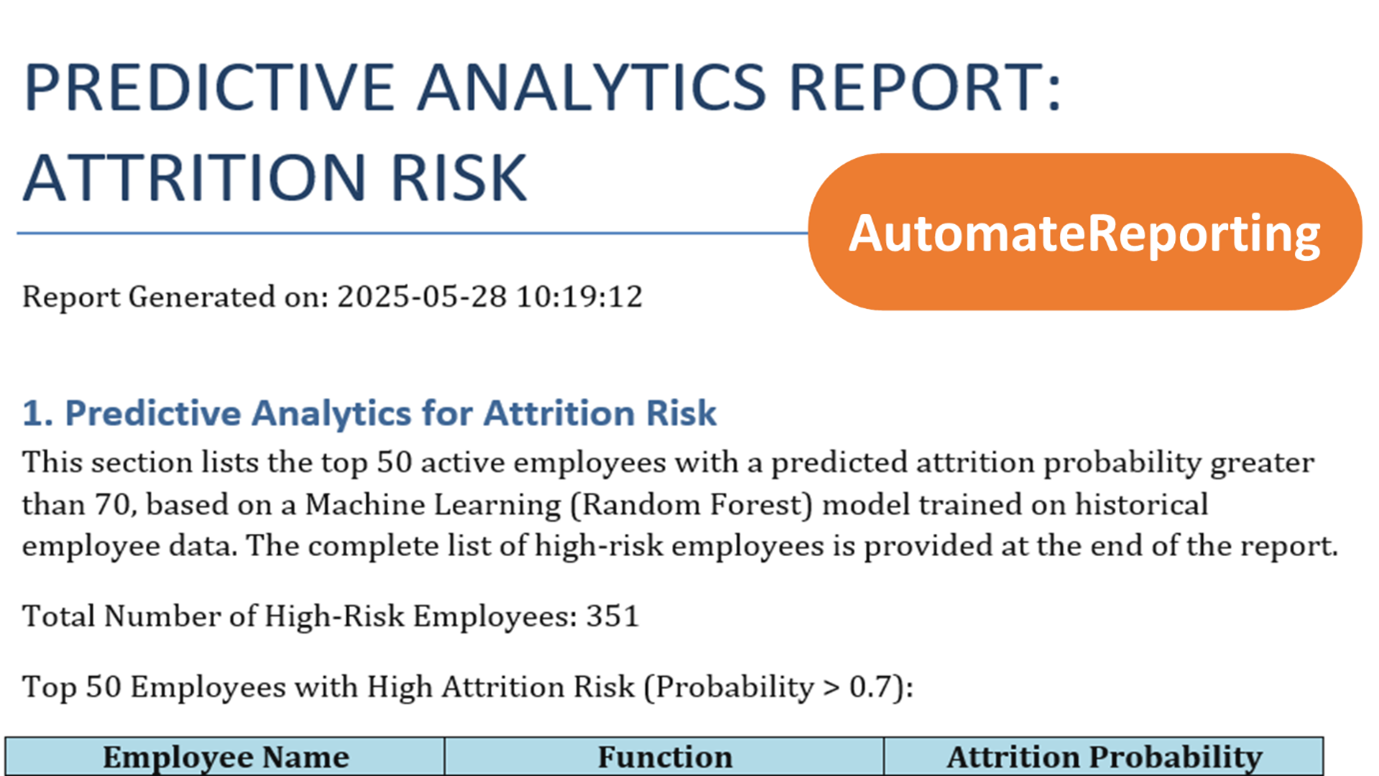
    High-risk employees: 12. Function-wise split: Done. Grade-wise pattern: Flagged. Individual flight risk probabilities: 0.82, 0.76, 0.91…

    95% confidence. Generated in five seconds. By a Random Forest Model trained on separation trackers, tenure trends, compensation shifts, and a few things we’re not supposed to admit HR tracks.

    He looked up. “That’s not how HR works.”

    I smiled.

    Maybe it should be.

    The AI Revolution in HR Analytics: Beyond Traditional Workforce Management

    This wasn’t magic. Just math with purpose.

    We built an AI Agent for employee retention. Not to replace HR judgment—but to upgrade it.

    The predictive analytics system does 3 things HR teams dream of but rarely dare to ask for:

    • Predict employee attrition before it becomes a headline
    • Quantify individual flight risk with probabilities—months in advance
    • Automate workforce analytics reports—by function, location, grade, and tenure

    The AI Revolution in HR Analytics: Beyond Traditional Workforce Management

    This wasn’t magic. Just math with purpose.

    We built an AI Agent for employee retention. Not to replace HR judgment—but to upgrade it.

    The predictive analytics system does 3 things HR teams dream of but rarely dare to ask for:

    • Predict employee attrition before it becomes a headline
    • Quantify individual flight risk with probabilities—months in advance
    • Automate workforce analytics reports—by function, location, grade, and tenure

    No more Excel gymnastics. No more panicked calls before the Board meets. Just actionable insights in place of data noise.

    Why Traditional HR Analytics Fail at Employee Retention

    HR doesn’t need another dashboard.

    It needs decisions.

    Here’s the uncomfortable truth: We’ve spent the last decade building visibility. But very little of it translated to action.

    Predictive AI for HR bridges that gap. Not by giving us certainty, but by refining our doubt.

    When a manager says, “I didn’t see it coming,” you can now ask: “Or did you just not look in the right place?”

    The Transformation: From Reactive to Predictive HR

    So what happened next?

    The CHRO leaned back. Silent for a moment. Then:

    “Can we scale this?”

    Not “Is this real?” Not “Will employees resist?” Just a quiet, serious request: “Can we make this standard?”

    And that’s the shift AI brings to human resources. Not automation. Augmentation. Not replacing judgment. Sharpening it. Not removing the human. Revealing it.

    The Future of Workforce Analytics: Evidence-Based HR Decisions

    Employee attrition prediction will never be fully predictable. But ignorance? That’s now a choice.

    Final thought: In HR, we’ve always had instincts. Now, we have evidence. The question is—will we act on it?

    Ready to transform your HR analytics? The tools exist. The data exists. The only question is whether you’re ready to move from reactive to predictive workforce management. What’s your experience with AI in HR? Share your thoughts in the comments below.

  • Your Complete Guide Through the AI Jungle: From LLMs to Agentic AI

    Your Complete Guide Through the AI Jungle: From LLMs to Agentic AI

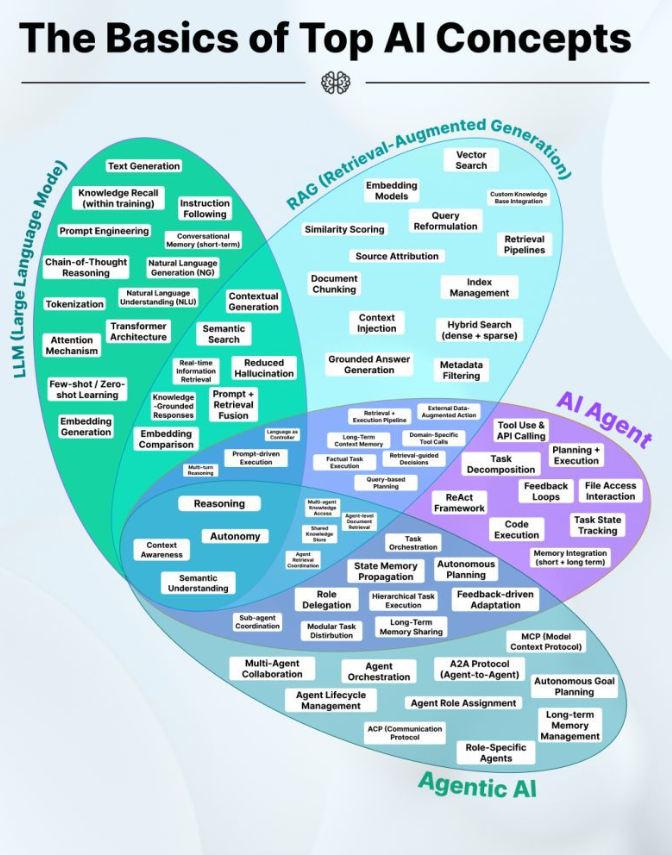
    The AI landscape isn’t a jungle of competing technologies—it’s a carefully architected intelligence stack that every enterprise needs to understand. After implementing AI systems across Fortune 500 companies, I’ve seen firsthand how the most successful organizations treat GenAI as layered infrastructure, not isolated tools.

    Let me break down the four-layer architecture that’s transforming how businesses operate.

    Layer 1: Large Language Models (The Foundation)

    Think of LLMs as your AI’s brain stem—they handle the core language processing that everything else builds on.

    What LLMs Actually Do:

    • Tokenize your text into processable chunks

    • Embed language into mathematical representations

    • Generate coherent, contextual responses

    • Follow instructions with remarkable accuracy

    • Reason through complex problems

    Reality Check: LLMs are incredibly powerful but fundamentally limited. They can’t access real-world data, can’t take actions, and can’t learn from new information. They’re pure language intelligence—nothing more, nothing less.

    Enterprise Applications That Work Right Now:

    • Content generation (I’ve seen 70% time savings in marketing teams)

    • Code completion and documentation

    • Initial customer service responses

    • Data analysis and report generation

    Layer 2: Retrieval-Augmented Generation (The Knowledge Bridge)

    RAG is where LLMs stop hallucinating and start being useful. It connects your AI to real, current information.

    Here’s what RAG actually fixes:

    The Hallucination Problem: LLMs confidently make up facts. RAG grounds responses in your actual data, reducing hallucinations by up to 85% in our implementations.

    How RAG Transforms Your AI:

    • Vector search finds semantically similar content across millions of documents

    • Document chunking breaks your knowledge base into searchable pieces

    • Source grounding links every response back to specific information

    • Real-time access to live databases and APIs

    Game-Changing Use Cases:

    • Internal knowledge management (one client reduced support ticket resolution time by 60%)

    • Compliance and regulatory guidance with audit trails

    • Customer support with product-specific accuracy

    • Research and competitive intelligence

    Layer 3: AI Agents (Where Talk Becomes Action)

    This is where things get interesting. AI Agents are where your AI stops talking and starts doing.

    What Makes Agents Different:

    • Planning: Breaking complex tasks into executable steps

    • Tool usage: Actually calling APIs and interacting with systems

    • State management: Remembering context across multi-step processes

    • Decision making: Choosing the right action based on current situation

    Real Impact: One manufacturing client uses AI agents to manage their entire supply chain exception handling. What used to take hours of human coordination now happens in minutes, automatically.

    Enterprise Agent Applications:

    • Process automation end-to-end

    • Customer journey orchestration

    • IT operations and incident response

    • Sales pipeline management

    Layer 4: Agentic AI (The Orchestration Layer)

    Agentic AI is where multiple intelligent agents collaborate, assign roles, share memory, and pursue complex goals together.

    This isn’t science fiction—it’s happening now in leading enterprises.

    What Agentic AI Enables:

    • Multi-agent collaboration across different business functions

    • Dynamic role assignment based on expertise and workload

    • Shared memory systems creating institutional knowledge

    • Goal adaptation as situations evolve

    • Autonomous coordination without human intervention

    Success Story: A financial services firm uses agentic AI to manage their entire trading operations. Multiple specialized agents handle market analysis, risk assessment, execution, and reporting—collaborating in real-time to optimize portfolio performance.

    How The Complete Stack Works Together

    Here’s a real-world example from customer service:

    1. LLM Layer: Understands customer inquiry in natural language

    2. RAG Layer: Retrieves relevant product documentation and customer history

    3. Agent Layer: Routes tickets, schedules follow-ups, escalates when needed

    4. Agentic Layer: Coordinates across support, billing, and technical teams automatically

    Result: 78% of customer issues resolved without human intervention, 45% faster resolution times.