Category: Blog

Your blog category

  • Spelling mistakes in CV can get your hired

    Spelling mistakes in CV can get your hired

    AI is fundamentally altering graduate employment. New graduates face both unprecedented challenges and remarkable opportunities as the job market transforms.

    The Numbers Tell a Compelling Story

    Entry-level positions have dropped by 30% in some sectors, with graduate vacancies plummeting from 400 to just 75 at major recruitment firms. However, this isn’t simply about AI replacing humans—it’s creating new opportunities.

    Key Statistics:

    • 50% of graduates now use AI for job applications (up from 38% last year)
    • Employers now see spelling mistakes as signs of authenticity
    • 60% of UK workforce works in SMEs that desperately need AI skills

    New Career Opportunities Are Emerging

    The AI revolution is creating entirely new career paths:

    • AI Ethics Specialists: Ensuring responsible AI implementation
    • Prompt Engineers: Optimizing AI interactions for maximum efficiency
    • AI Implementation Consultants: Helping businesses integrate AI solutions

    These roles didn’t exist five years ago, yet they’re now among the fastest-growing opportunities.

    The Hidden Opportunity: Small-to-Medium Enterprises

    While graduates compete for corporate positions, SMEs offer massive untapped opportunities. These companies face unique challenges:

    • Limited resources for AI implementation
    • Lack of in-house technical expertise
    • Uncertainty about AI’s practical applications
    • Need for cost-effective solutions

    Graduates with practical AI knowledge become invaluable assets with less competition.

    The Skills Gap Crisis

    Universities can’t keep pace with AI literacy training. Self-educated graduates gain substantial competitive advantages.

    Essential AI Skills:

    Technical:

    • Machine learning fundamentals
    • AI tools (ChatGPT, Claude, industry software)
    • Data analysis and automation platforms

    Soft Skills:

    • Critical thinking about AI limitations
    • Ethical reasoning for AI applications
    • Communication skills for non-technical stakeholders

    Strategic Career Advice

    1. Master AI Application

    • Build personal projects showcasing AI problem-solving
    • Create freelance work helping small businesses
    • Develop a portfolio of AI-enhanced work examples

    2. Target Underserved Markets

    • SMEs in traditional industries ready for transformation
    • Startups needing AI expertise
    • Non-profit organizations seeking efficiency improvements

    3. Become an AI Translator

    Bridge the gap between AI capabilities and business applications:

    • Explain AI benefits in business terms
    • Identify specific use cases within organizations
    • Train colleagues on AI tools and best practices

    Future Job Market Predictions

    • Hybrid roles combining traditional skills with AI proficiency will become standard
    • AI literacy will be as essential as computer literacy was in the 1990s
    • Human-AI collaboration skills will differentiate top candidates

    Taking Action: Your Next Steps

    Current Graduates:

    Identify relevant AI tools for your field
    Complete practical AI projects
    Build an AI-enhanced portfolio
    Network with SME leaders
    Specialize in AI ethics or implementation

    Students:

    Supplement coursework with AI learning
    Seek AI-focused internships
    Join AI student organizations
    Develop AI-incorporated capstone projects

    Conclusion: Embrace the AI Advantage

    The graduate job market is transforming, not disappearing. Those who recognize AI as an opportunity multiplier will thrive. The most successful graduates will master AI application and help others navigate this technological revolution.

    The future belongs to graduates who can apply AI to solve real business problems. The question isn’t whether you’ll be affected—it’s whether you’ll be leading the change.

    What changes are you seeing in your industry? Share your experiences with AI’s impact on graduate opportunities in the comments below.

    50% of graduates now use AI for job applications (up from 38% last year)
    Employers now see spelling mistakes as signs of authenticity
    60% of UK workforce works in SMEs that desperately need AI skills
  • The Illusion of Intelligence: When Reasoning AIs Fail the Age Test

    The Illusion of Intelligence: When Reasoning AIs Fail the Age Test

    The Simple Question That Breaks AI
    Three years ago, John was 30.What’s his age today?
    Ask a 5-year-old, and you’ll get a confident “33.”Ask a cutting-edge LLM? You might hear, “John is still 30.”
    That’s not a joke. I ran this prompt through multiple local models, including Cogito 3B and a couple of community-favorite LLMs. Two froze mid-reasoning. One hallucinated. Another confidently clung to “30” as if time itself had paused for John Smith. I had to force stop the models before they spiraled into existential loops.
    That’s when I stumbled upon Apple’s quietly released research:“Reasoning in Large Language Models: A Structural Examination of LRMs”
    This wasn’t just a paper. It was a mirror held up to our collective AI hype.

    Apple’s Quiet Bombshell
    The research doesn’t scream headlines. But if you read between the lines, the message is brutal:

    Large Reasoning Models (LRMs) aren’t reasoning. They’re rehearsing — and they stumble once the stage changes.

    Apple’s team didn’t just test for final answer accuracy (the usual game of solving math or code questions). Instead, they controlled compositional complexity — adjusting the logic of puzzles while holding structure steady. This allowed them to peer inside the how, not just the what.
    The findings?
    1. Reasoning collapses at complexity: As puzzles grow more layered, models hit a point where thinking efforts don’t rise — they shrink. The AI starts doing less when asked for more.
    2. Surprising underdogs: On simple tasks, old-school LLMs (with no fancy reasoning prompts) often outperformed the so-called smarter LRMs. Because brute fluency > half-baked logic.
    3. Three-tiered failure curve:

    Simple tasks → LLMs win.
    Medium tasks → LRMs shine with their verbose reasoning.
    Hard tasks → Both fall apart. Sometimes poetically.

    4. Inconsistent computation: Models don’t follow stable algorithms. Ask them to solve similar puzzles with tiny differences? Expect wildly different approaches. Like solving one with algebra and the next with vibes.

    My John Smith Moment
    I didn’t need a research lab to feel this.
    I asked a 3B LLM to solve:“John was 30 years old 3 years ago. What’s his age now?”
    First response:

    “John is 30.”

    Second response:

    “John is still 30 because 3 years ago, he was 30.”

    No reasoning. Just repetition.It was like watching a parrot misquote Socrates.
    I added a prompt to “think step-by-step.”It generated a four-line explanation — all correct-sounding — ending again with: “John is 30.”
    In other words, the reasoning trace sounded intelligent but led nowhere.
    Apple’s paper helped me decode this:These models simulate reasoning — they don’t execute it.

    So What Do We Do With This?
    If you’re a leader relying on LLMs for decision-support, this should be your wake-up call.
    The future of AI isn’t just in scaling up — it’s in slowing down.Tracing how a model thinks. Catching the wrong steps before they become decisions.
    Right now, we’re betting billions on models that sound wise — but can’t age John by three years.

    Final Thought: Are We Building Thinkers or Talkers?
    The next time you hear an LLM explain something with confidence, pause.Ask yourself: Is it thinking? Or just echoing the patterns of people who once did?
    And if John’s still 30 in that world — maybe we’re the ones who need to grow up.

    Key Takeaways

    Apple’s research reveals that Large Reasoning Models simulate rather than execute true reasoning
    Simple arithmetic problems expose fundamental flaws in AI reasoning capabilities
    Complexity scaling shows inverse relationship between task difficulty and model performance
    Business leaders should implement reasoning verification systems before relying on AI decisions
    The AI industry needs to focus on reasoning quality, not just conversational fluency

    Want to stay updated on AI reasoning breakthroughs and failures? Follow for more insights on the reality behind the AI hype.


  • ReAct vs. ReWOO: Inside the Minds of AI Agents

    ReAct vs. ReWOO: Inside the Minds of AI Agents

    Welcome back.
    In the previous post, we explored what AI agents are and why

    Welcome back.

    In the previous post, we explored what AI agents are and why they matter more than ever. Now, let’s open the black box and see how these agents think, plan, and act.

    Spoiler: they don’t just follow instructions — they reason like humans. And sometimes better.

    ReAct: Reason, Act, Reflect

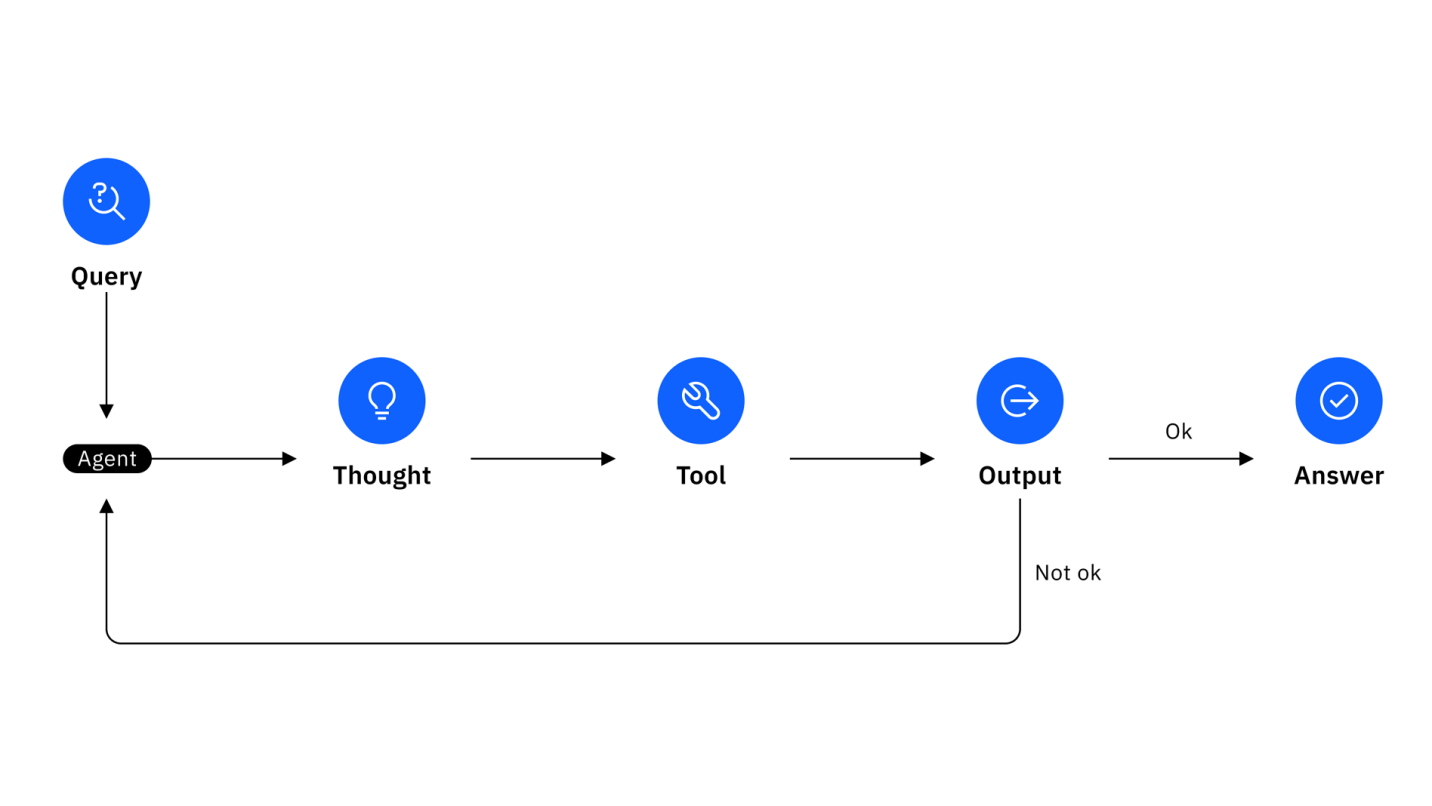
    ReAct (Reasoning and Action) is a framework that lets AI agents think, act, and observe in a loop.

    How it works:

    The agent receives a user prompt.
    It reasons step-by-step — articulating its thought process.
    It takes an action (e.g., calling a tool).
    It observes the result.
    Based on the result, it reasons again and updates its plan.

    This iterative loop is like a human solving a puzzle — experimenting, reflecting, and refining.

    Why it matters:

    • It supports complex, unpredictable tasks.
    • It’s transparent — you see the agent’s reasoning in real time.
    • It helps debug or retrain the agent more easily.

    ReWOO: Plan Once, Act Smart

    ReWOO (Reasoning Without Observation) takes a different approach.

    Instead of reacting after every step, the agent plans everything upfront, executes in bulk, and evaluates at the end.

    Workflow:

    The agent anticipates what tools and data it will need.
    It collects everything it needs at once.
    It combines the results and delivers a final output.

    Why it matters:

    • Faster execution.
    • Less computational cost.
    • Reduces risk from tool failure or API rate limits.
    • More aligned with enterprise-scale, multi-tool workflows.

    Types of AI Agents: From Reflex to Learning

    Not every agent is built the same. Here’s a hierarchy — from simplest to most advanced:

    1. Simple Reflex Agents

    Hard-coded rules. No learning or context memory.

    2. Model-Based Reflex Agents

    Can track some internal state for better decisions.

    3. Goal-Based Agents

    Plan actions based on goals, not just rules.

    4. Utility-Based Agents

    Optimize based on outcomes and tradeoffs.

    5. Learning Agents

    Improve continuously with feedback, experience, or user interaction.

    Why This Matters for You

    If you’re still deploying bots or assistants in your workflows, you’re solving today’s problems with yesterday’s tools.

    AI agents are:

    • Smarter than bots.
    • More independent than assistants.
    • More scalable than human teams.

    Whether you’re automating HR processes, sales reports, IT tickets, or customer service — agents are the next layer of business performance.

    Final Thought

    When software starts thinking, planning, and executing on your behalf — your role changes from operator to orchestrator.

    So ask yourself:

    Are you building tools? Or are you assembling agents?

    Because those who build agents now… …won’t be building slide decks later.

    Related: Read Part 1: What Are AI Agents? And Why They’re Not Just Fancy Chatbots to understand the fundamentals of AI agents.

  • You’re Just a Number: Why AI Can’t Fix What HR Gets Wrong About Human Value

    A software engineer’s viral story reveals the hidden cost of treating employees like data points—and why your AI-powered HR strategy might be missing the most important metric of all.


    The Story That Broke the Internet (And Every HR Assumption)

    A software engineer’s story recently went viral.

    Not because it was dramatic. But because it was accurate.

    His manager told him: “You’re just a number to us.”

    And something in that sentence triggered a quiet rebellion across the workforce.

    What Happens When AI Meets “Employees as Numbers”

    Let’s test that philosophy with artificial intelligence.

    Feed HR data into an AI model. Lay off 400 people based on “cost per head” and “productivity delta.”

    The spreadsheet will smile. The dashboard will glow green. The CFO will approve.

    But here’s what the model won’t know:

    • Raj from Payroll who reverse-engineered a broken ERP script
    • Arti from Ops who trained the AI model itself
    • And the engineer? He trained the AI bot that may now be writing his replacement code

    Data Sees Quantity. People Bring Quality.

    The engineer had been:

    • Covering for two exits
    • Delivering KPIs silently
    • Winning client praise

    No noise. No drama. Just delivery.

    But when he asked for a raise? Silence.

    So, he did what every algorithm is taught to do: He optimized for his own outcome.

    In two weeks:

    • A 40% salary hike
    • Better perks
    • A culture that valued his human edge

    When he resigned, the same team that ignored him scrambled to retain him.

    Too late.

    The Invisible Labor AI Doesn’t Capture

    Here’s the problem with HR analytics:

    AI models optimize for patterns. They don’t understand emotional debt.

    They can quantify attrition risk. But they can’t feel loyalty erosion.

    They can suggest retention bonuses. But they don’t know when someone has already left… mentally.

    HR Dashboards vs Human Truth: The Disconnect

    Most CEOs don’t know Raj or Arti.

    They know:

    • “We’re at 812 FTEs”
    • “Cost per head up 9%”
    • “Let’s automate onboarding and exit interviews”

    But here’s the danger:

    You can automate reporting. You can’t automate respect.

    A chatbot won’t fix broken culture. A dashboard won’t rebuild trust.

    The engineer wasn’t just a number.

    He was the reason your AI insights made sense in the first place.

    The Real Future of HR + AI: Beyond Analytics

    Not just analytics. Not just dashboards. But empathy at scale.

    Use AI to clean data. Not to erase humanity.

    Let machines calculate the “how many.” But let leaders remember the “who.”

    Because a company without its people isn’t agile. It’s empty.

    And the real risk isn’t just resignation. It’s resentment hidden in engagement scores and false positives.

    The Bottom Line: Human Value in an AI World

    You can count employees. But if you don’t value them, AI won’t save you.

    In fact, it might just show you—faster—how quickly your best talent walks away.

    The future of work isn’t about replacing human judgment with algorithms. It’s about using technology to amplify human potential while never forgetting that behind every data point is a person who chose to show up.


    Ready to build HR strategies that value people over numbers?

    Connect with us to explore how AI can enhance—not replace—the human side of your workplace.

  • How Companies Are Restructuring for Generative AI Success: The Complete Leadership Guide (Part 1)

    Artificial intelligence isn’t just knocking at the door. It’s moved in, rearranged the furniture, and now it’s eyeing your organizational chart.

    The latest McKinsey Global Survey on artificial intelligence reveals that the winners in the generative AI race aren’t necessarily the most tech-savvy companies. They’re the best organized. The real disruptor? AI leadership structure and organizational design.

    Welcome to Part 1 of our comprehensive 2-part series on how companies are organizing for generative AI success. Today, we examine AI leadership, centralization strategies, and organizational scale. Part 2 will explore AI workflows, risk management, and execution best practices.

    CEO Leadership in AI Governance: The Primary Success Factor

    McKinsey’s most significant finding? CEO oversight of AI governance is the number one predictor of bottom-line impact from generative AI implementation.

    Not AI model quality. Not cloud infrastructure maturity. Not data architecture sophistication. Just one critical factor: executive accountability for AI strategy.

    Only 28% of AI-using organizations have CEOs directly owning AI governance responsibilities. However, at enterprise companies over $500M in revenue, this CEO leadership correlates strongly with measurable EBIT growth from AI initiatives.

    Why does CEO involvement in AI governance matter so much? Because successful AI transformation isn’t a technology project—it’s a comprehensive business transformation requiring: cross-functional orchestration, bold resource reallocation, and cultural transformation. In other words, C-suite territory.

    Some organizations take this even further—17% involve board-level AI oversight. Artificial intelligence has officially become a boardroom priority.

    AI Centralization Strategy: Selective Approach for Maximum Impact

    The next crucial insight from the research? Selective AI centralization strategies outperform both fully centralized and completely decentralized approaches.

    Successful companies centralize foundational AI elements that require uniform standards across the organization:

    • AI risk management and compliance
    • Enterprise data governance for AI
    • Responsible AI policies and ethics

    These foundational elements run through AI Centers of Excellence that establish guardrails for the entire organization.

    Simultaneously, they distribute AI execution elements where domain expertise and local context matter most:

    • AI solution implementation
    • Business use-case identification
    • AI talent deployment and training

    This approach combines centralized AI governance with distributed innovation. Think: enterprise AI playbooks enabling local experimentation.

    Enterprise Scale Advantages in AI Transformation

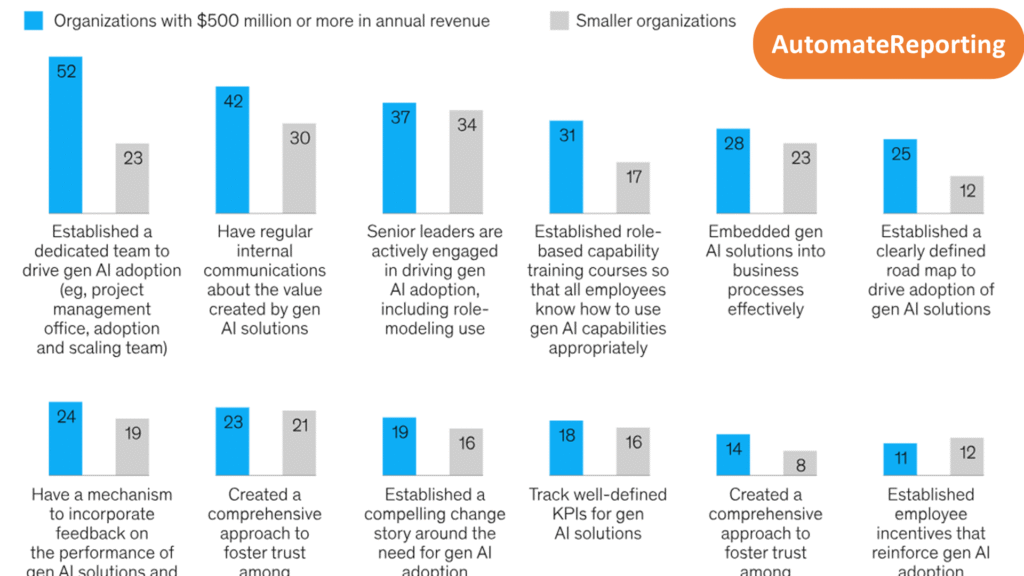
    Organizational size significantly impacts AI adoption success. Larger enterprises ($500M+ annual revenue) demonstrate more than twice the likelihood to:

    • Establish comprehensive AI roadmaps and strategies
    • Build dedicated AI transformation teams
    • Implement enterprise AI governance frameworks

    These represent systematic AI transformations, not isolated pilot projects.

    However, smaller companies possess distinct competitive advantages: operational agility, faster decision-making, and minimal legacy system constraints. The window for AI first-mover advantage remains open for organizations of all sizes.

    Current State of Enterprise AI Maturity

    Despite widespread AI discussion, only 1% of companies describe their generative AI rollouts as “mature.” This statistic represents both a challenge and a significant market opportunity.

    The strategic opportunity? Organizations can establish competitive advantages while industry best practices are still emerging. Building foundational AI capabilities now positions companies for long-term success.

    Essential AI Leadership Actions for 2025

    Based on McKinsey’s research findings, four critical organizational moves emerge:

    1. Elevate AI Governance to Executive Leadership AI strategy requires C-suite ownership, not IT department delegation. Executive leadership ensures AI initiatives align with business objectives.

    2. Implement Selective AI Centralization Centralize governance, risk management, and data standards. Distribute implementation and use-case development for maximum agility.

    3. Approach AI as Organizational Transformation Successful AI adoption requires cultural evolution, not just technology implementation. Organizational structure, incentives, and processes must adapt.

    4. Establish Multi-Stakeholder AI Ownership Shared AI governance across departments outperforms single-function ownership models.

    Next Steps in AI Organizational Design

    This comprehensive guide focuses on deploying AI tools effectively by redesigning organizational foundations.

    In Part 2 of this series, we’ll explore:

    • AI workflow redesign strategies for operational excellence
    • Scalable AI use case development methodologies
    • AI risk management frameworks that enable innovation

    This decade belongs to organizations that structure for AI success early.

    The critical question isn’t whether your company will use artificial intelligence. It’s whether your organizational structure will enable AI to succeed.


    Key Takeaways:

    • CEO oversight of AI governance correlates directly with business impact
    • Selective centralization outperforms fully centralized or decentralized AI approaches
    • Enterprise scale provides systematic advantages, but smaller companies can leverage agility
    • Only 1% of companies have mature AI deployments, creating first-mover opportunities

    Research Source: McKinsey Global Survey on AI (2024) – comprehensive cross-industry study analyzing how companies structure for AI-driven business impact.

  • A Practical Guide to Building AI Agents for HR: OpenAI’s Blueprint for Workforce Transformation

    What Are AI Agents for HR, Really?

    Imagine a system that doesn’t just answer your question—it flags an employee at risk of attrition, drafts the manager notification, triggers an action plan, and updates the HRMS.

    That’s not a feature. That’s an HR AI agent.

    AI Agents for human resources are intelligent workflow executors. They’re powered by Large Language Models (LLMs), connected to tools, guided by goals—and increasingly, present in your HR meetings.

    If HR still thinks this is “someone else’s transformation,” it may be the last memo they miss.


    What OpenAI’s AI Agents Guide Really Says (for Real HR Workflows)

    Link – https://cdn.openai.com/business-guides-and-resources/a-practical-guide-to-building-agents.pdf

    AI Agents in HR are not experiments. They’re becoming best practice. Here’s what the guide clarifies:

    Agents handle complexity where rule-based systems fail Think of processes like workforce forecasting, sentiment analysis, or policy interpretation.

    Three things every HR AI agent needs

    • A Model (GPT-4o, for instance) to reason
    • Tools (APIs, databases, HRMS connectors) to act
    • Instructions (clear objectives) to execute

    Orchestration is a journey You don’t start with a swarm of agents. You start with one that handles one HR automation task better than a human ever could—and build from there.

    Guardrails are non-negotiable OpenAI is firm: build in safety, bias checks, and ethical layers. Not just for legal protection—but for trust.

    Start small. Validate. Expand. A good agent doesn’t need fanfare. It needs data, direction, and a clear job to do.

    Why HR Can’t Sit Out the AI Agent Revolution

    Because the AI agents for workforce management aren’t coming for HR. They’re already inside the firewall.

    In companies that have begun the shift, HR tasks like:

    • Generating automated HR reports
    • Predicting employee attrition
    • Processing grievances
    • Flagging burnout risks
    • Personalizing employee engagement plans

    are no longer handled by teams. They’re handled by intelligent HR agents—working 24/7, across geographies, without dashboards or reminders.

    The result isn’t fewer HR people. It’s HR people doing less admin and more actual human strategy.

    The HR AI Agent by AutomateReporting

    We didn’t wait for theory. We built the agent.

    AutomateReporting’s HR AI Agent


    • Focused on workforce insights, retention analytics, and automated reporting

    What it does:

    • Predicts attrition with up to 95 percent confidence
    • Segments risk by grade, function, tenure, and geography
    • Automates narrative reports—no Excel, no slides
    • Accepts natural language queries from business users

    It doesn’t do HR’s job. It gives HR the space to do it better.

    https://automatereporting.com


    The Future of HR: From Manual to Automated Intelligence

    Final Thought

    OpenAI gave us the blueprint for AI agents. But blueprints don’t build outcomes.

    You don’t need to hire 10 data scientists. You don’t need to rebuild your tech stack.

    You need one problem worth solving. One HR AI agent worth deploying.

    And the courage to ask:

    What else are we still doing manually that an AI agent could do… better, faster, and now?

    Ready to implement AI agents in your HR workflow? The technology exists. The blueprint is public. The only question is whether you’ll lead the transformation or watch from the sidelines.


  • “You can’t predict Employee attrition like that.”

    The CHRO said it flatly. Not as a challenge. As a truth of the HR universe. The kind uttered after decades of battling dashboards, gut feel, and last-minute exit interviews.

    I didn’t respond. Just opened my laptop.

    “Watch.”

    He leaned forward. I hit run. Five seconds. The screen blinked.

    A clean report emerged. Not a dashboard. A verdict.

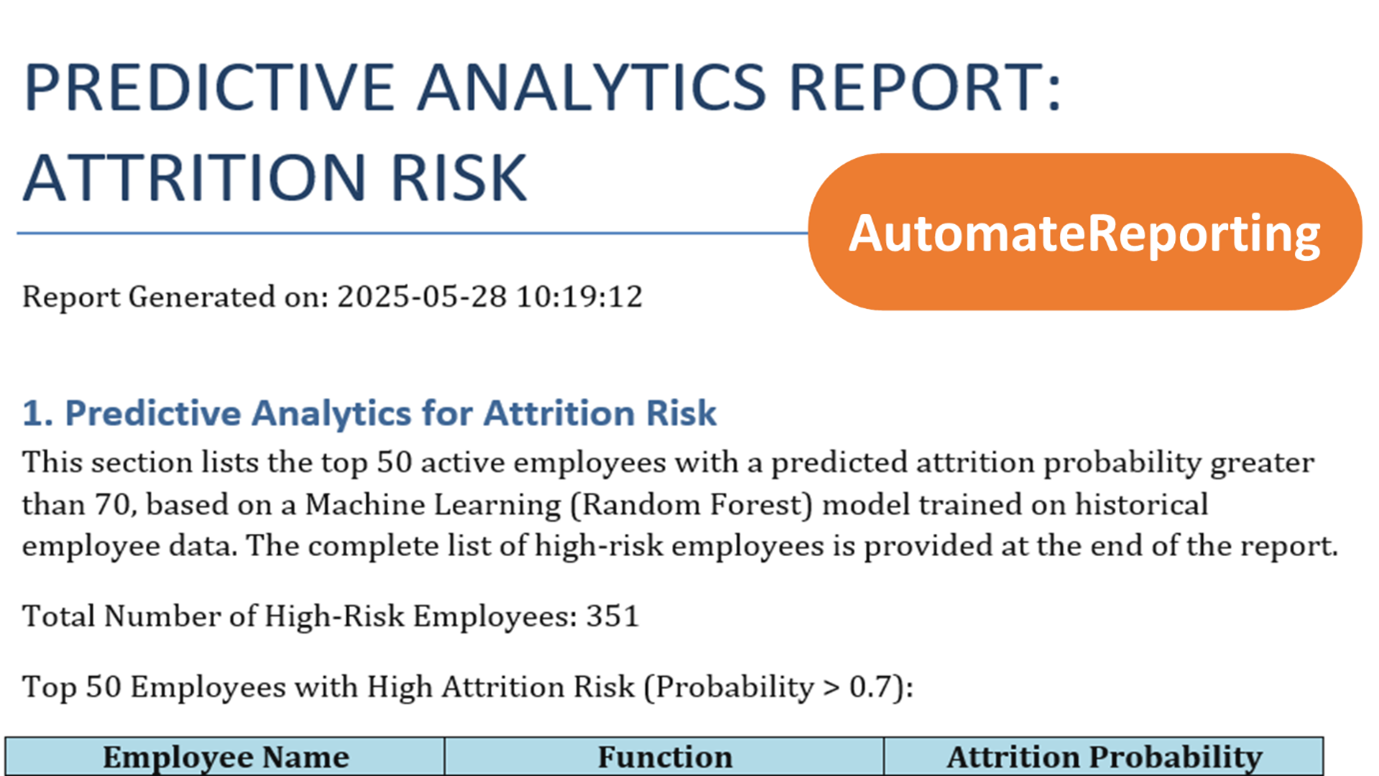
    High-risk employees: 12. Function-wise split: Done. Grade-wise pattern: Flagged. Individual flight risk probabilities: 0.82, 0.76, 0.91…

    95% confidence. Generated in five seconds. By a Random Forest Model trained on separation trackers, tenure trends, compensation shifts, and a few things we’re not supposed to admit HR tracks.

    He looked up. “That’s not how HR works.”

    I smiled.

    Maybe it should be.

    The AI Revolution in HR Analytics: Beyond Traditional Workforce Management

    This wasn’t magic. Just math with purpose.

    We built an AI Agent for employee retention. Not to replace HR judgment—but to upgrade it.

    The predictive analytics system does 3 things HR teams dream of but rarely dare to ask for:

    • Predict employee attrition before it becomes a headline
    • Quantify individual flight risk with probabilities—months in advance
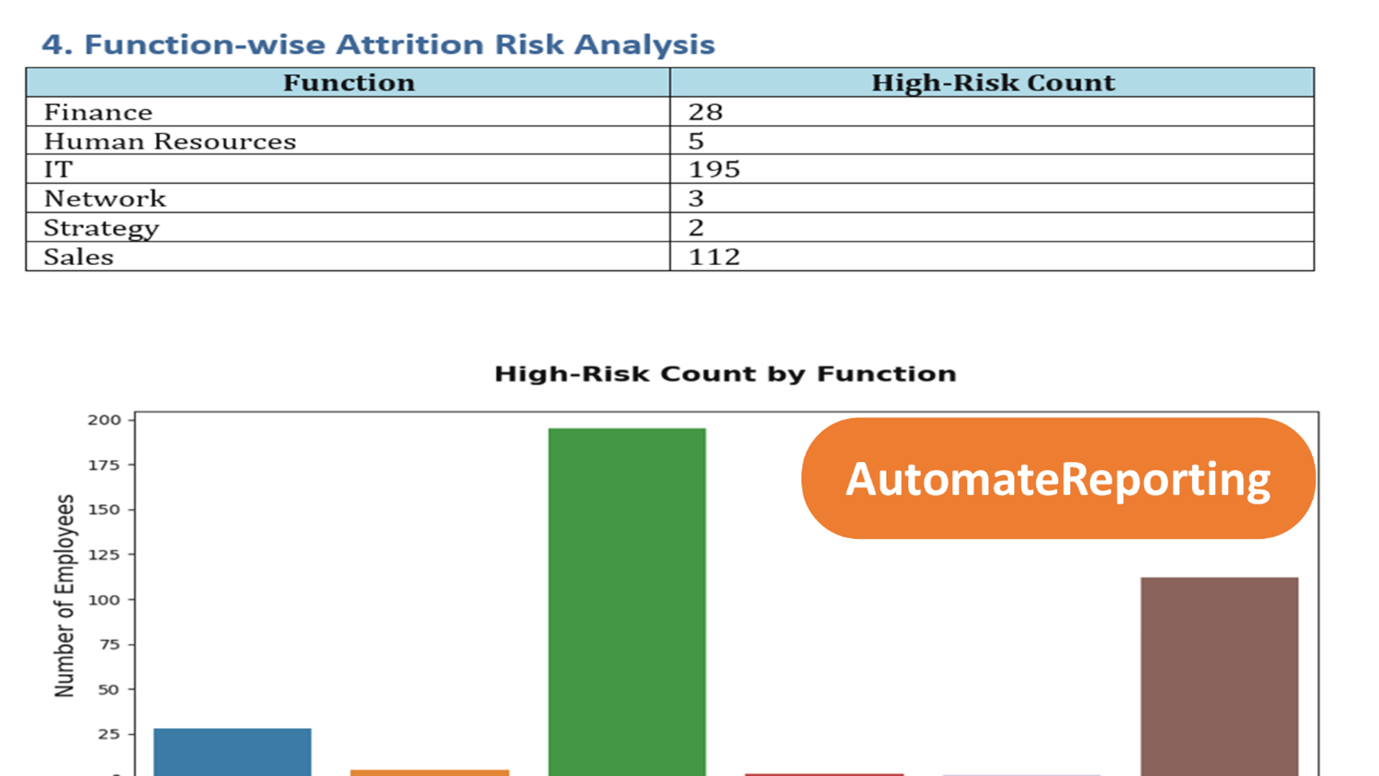
    • Automate workforce analytics reports—by function, location, grade, and tenure

    The AI Revolution in HR Analytics: Beyond Traditional Workforce Management

    This wasn’t magic. Just math with purpose.

    We built an AI Agent for employee retention. Not to replace HR judgment—but to upgrade it.

    The predictive analytics system does 3 things HR teams dream of but rarely dare to ask for:

    • Predict employee attrition before it becomes a headline
    • Quantify individual flight risk with probabilities—months in advance
    • Automate workforce analytics reports—by function, location, grade, and tenure

    No more Excel gymnastics. No more panicked calls before the Board meets. Just actionable insights in place of data noise.

    Why Traditional HR Analytics Fail at Employee Retention

    HR doesn’t need another dashboard.

    It needs decisions.

    Here’s the uncomfortable truth: We’ve spent the last decade building visibility. But very little of it translated to action.

    Predictive AI for HR bridges that gap. Not by giving us certainty, but by refining our doubt.

    When a manager says, “I didn’t see it coming,” you can now ask: “Or did you just not look in the right place?”

    The Transformation: From Reactive to Predictive HR

    So what happened next?

    The CHRO leaned back. Silent for a moment. Then:

    “Can we scale this?”

    Not “Is this real?” Not “Will employees resist?” Just a quiet, serious request: “Can we make this standard?”

    And that’s the shift AI brings to human resources. Not automation. Augmentation. Not replacing judgment. Sharpening it. Not removing the human. Revealing it.

    The Future of Workforce Analytics: Evidence-Based HR Decisions

    Employee attrition prediction will never be fully predictable. But ignorance? That’s now a choice.

    Final thought: In HR, we’ve always had instincts. Now, we have evidence. The question is—will we act on it?

    Ready to transform your HR analytics? The tools exist. The data exists. The only question is whether you’re ready to move from reactive to predictive workforce management. What’s your experience with AI in HR? Share your thoughts in the comments below.