Blog

  • Have LLMs Become Intelligent? Not Quite Yet.

    Have LLMs Become Intelligent? Not Quite Yet.

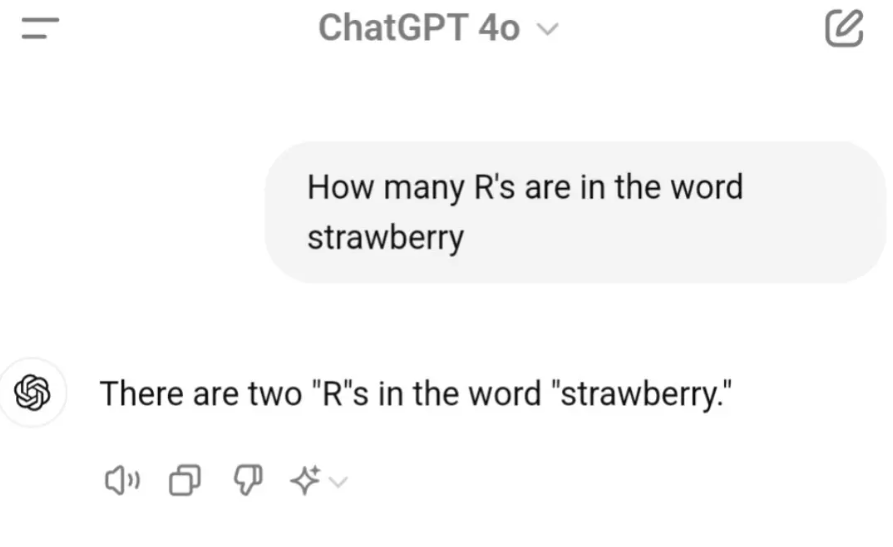
    In the world of AI, there’s a growing myth — that large language models (LLMs) are already intelligent.

    They’re not.

    Let me explain with a test I ran this week.

    The Setup: A Simple Reasoning Task

    I asked a few open-source models a straightforward prompt:

    “John Smith was 30 years old 3 years ago. What is John’s age now?”

    This isn’t a trick question. It’s elementary time math — the kind we expect any reasoning system to solve easily.

    Here’s what happened.

    • DeepSeek R1 responded: 33
    • LLaMA 3.2 responded: 33
    • Cogito 3B… broke.

    And I don’t mean it got the answer wrong.

    The Breakdown

    Cogito didn’t just misfire. It collapsed into a loop.

    It began analyzing every word, second-guessing the phrasing, debating the nature of “3 years ago,” and exploring all possible meanings of “as of.”

    It asked itself questions like:

    • What if “3 years ago” is a reference to the writing date?
    • Could the phrase mean he was 3 years old in 2022?
    • Was there a typo?
    • Is time even real?

    It felt less like a model running inference and more like an undergrad overthinking a philosophy exam.

    Eventually, it became so confused that I had to manually force stop it. The model couldn’t recover.

    The Bigger Point: Intelligence ≠ Language Fluency

    This is not a criticism of Cogito specifically — it’s a reminder of the gap that still exists.

    LLMs are excellent at language generation. They can summarize, rephrase, autocomplete, and simulate conversation. But reasoning — especially controlled, convergent reasoning — is still fragile.

    What we’re seeing isn’t intelligence. It’s statistical mimicry wrapped in good grammar.

    DeepSeek and LLaMA got lucky here. But ask them a layered, multi-hop, or slightly ambiguous question and they too will falter — sometimes elegantly, sometimes catastrophically.

    Where We Are, Really

    This small test reveals something fundamental: most LLMs don’t know when to stop thinking. They don’t yet possess guardrails for converging on the obvious. They’re not “dumb,” but they’re also not what we’d call intelligent.

    In human terms, they’re articulate overthinkers — capable of writing essays but unsure whether 30 + 3 = 33.

    So no, LLMs aren’t intelligent. Not yet. But they’re fascinatingly close. And sometimes, dangerously confident.

    Maybe Apple researchers are right.

    Have you seen similar breakdowns in local models? I’d love to hear how they handled basic logic.
  • How Companies Are Restructuring for Generative AI Success: The Complete Leadership Guide (Part 1)

    Artificial intelligence isn’t just knocking at the door. It’s moved in, rearranged the furniture, and now it’s eyeing your organizational chart.

    The latest McKinsey Global Survey on artificial intelligence reveals that the winners in the generative AI race aren’t necessarily the most tech-savvy companies. They’re the best organized. The real disruptor? AI leadership structure and organizational design.

    Welcome to Part 1 of our comprehensive 2-part series on how companies are organizing for generative AI success. Today, we examine AI leadership, centralization strategies, and organizational scale. Part 2 will explore AI workflows, risk management, and execution best practices.

    CEO Leadership in AI Governance: The Primary Success Factor

    McKinsey’s most significant finding? CEO oversight of AI governance is the number one predictor of bottom-line impact from generative AI implementation.

    Not AI model quality. Not cloud infrastructure maturity. Not data architecture sophistication. Just one critical factor: executive accountability for AI strategy.

    Only 28% of AI-using organizations have CEOs directly owning AI governance responsibilities. However, at enterprise companies over $500M in revenue, this CEO leadership correlates strongly with measurable EBIT growth from AI initiatives.

    Why does CEO involvement in AI governance matter so much? Because successful AI transformation isn’t a technology project—it’s a comprehensive business transformation requiring: cross-functional orchestration, bold resource reallocation, and cultural transformation. In other words, C-suite territory.

    Some organizations take this even further—17% involve board-level AI oversight. Artificial intelligence has officially become a boardroom priority.

    AI Centralization Strategy: Selective Approach for Maximum Impact

    The next crucial insight from the research? Selective AI centralization strategies outperform both fully centralized and completely decentralized approaches.

    Successful companies centralize foundational AI elements that require uniform standards across the organization:

    • AI risk management and compliance
    • Enterprise data governance for AI
    • Responsible AI policies and ethics

    These foundational elements run through AI Centers of Excellence that establish guardrails for the entire organization.

    Simultaneously, they distribute AI execution elements where domain expertise and local context matter most:

    • AI solution implementation
    • Business use-case identification
    • AI talent deployment and training

    This approach combines centralized AI governance with distributed innovation. Think: enterprise AI playbooks enabling local experimentation.

    Enterprise Scale Advantages in AI Transformation

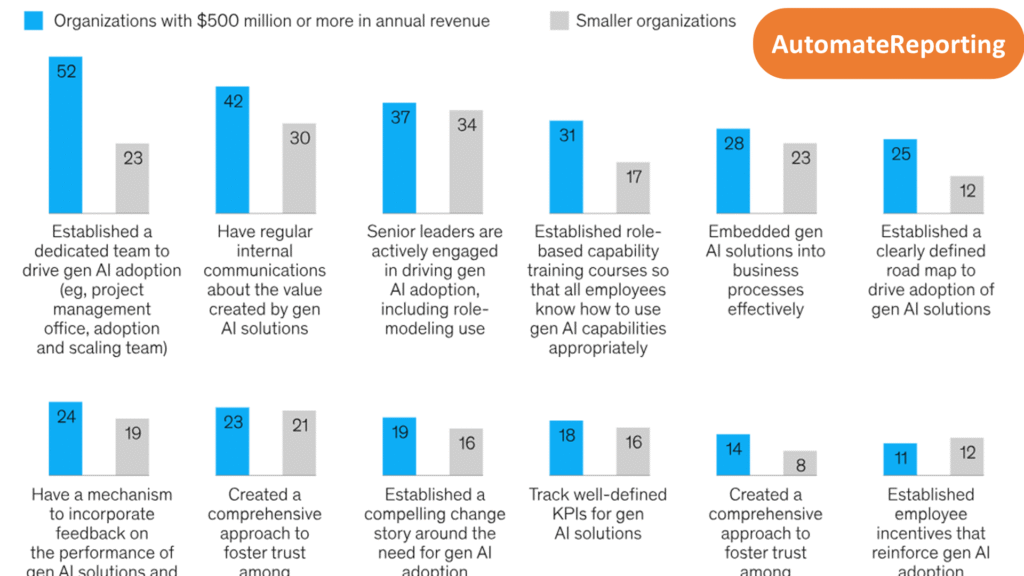
    Organizational size significantly impacts AI adoption success. Larger enterprises ($500M+ annual revenue) demonstrate more than twice the likelihood to:

    • Establish comprehensive AI roadmaps and strategies
    • Build dedicated AI transformation teams
    • Implement enterprise AI governance frameworks

    These represent systematic AI transformations, not isolated pilot projects.

    However, smaller companies possess distinct competitive advantages: operational agility, faster decision-making, and minimal legacy system constraints. The window for AI first-mover advantage remains open for organizations of all sizes.

    Current State of Enterprise AI Maturity

    Despite widespread AI discussion, only 1% of companies describe their generative AI rollouts as “mature.” This statistic represents both a challenge and a significant market opportunity.

    The strategic opportunity? Organizations can establish competitive advantages while industry best practices are still emerging. Building foundational AI capabilities now positions companies for long-term success.

    Essential AI Leadership Actions for 2025

    Based on McKinsey’s research findings, four critical organizational moves emerge:

    1. Elevate AI Governance to Executive Leadership AI strategy requires C-suite ownership, not IT department delegation. Executive leadership ensures AI initiatives align with business objectives.

    2. Implement Selective AI Centralization Centralize governance, risk management, and data standards. Distribute implementation and use-case development for maximum agility.

    3. Approach AI as Organizational Transformation Successful AI adoption requires cultural evolution, not just technology implementation. Organizational structure, incentives, and processes must adapt.

    4. Establish Multi-Stakeholder AI Ownership Shared AI governance across departments outperforms single-function ownership models.

    Next Steps in AI Organizational Design

    This comprehensive guide focuses on deploying AI tools effectively by redesigning organizational foundations.

    In Part 2 of this series, we’ll explore:

    • AI workflow redesign strategies for operational excellence
    • Scalable AI use case development methodologies
    • AI risk management frameworks that enable innovation

    This decade belongs to organizations that structure for AI success early.

    The critical question isn’t whether your company will use artificial intelligence. It’s whether your organizational structure will enable AI to succeed.


    Key Takeaways:

    • CEO oversight of AI governance correlates directly with business impact
    • Selective centralization outperforms fully centralized or decentralized AI approaches
    • Enterprise scale provides systematic advantages, but smaller companies can leverage agility
    • Only 1% of companies have mature AI deployments, creating first-mover opportunities

    Research Source: McKinsey Global Survey on AI (2024) – comprehensive cross-industry study analyzing how companies structure for AI-driven business impact.

  • AI Agents Won’t Replace HR But Will Transform How HR Works: Complete Guide 2025

    AI Agents Won’t Replace HR. But They’ll Replace the Way HR Works.

    AI Agents Won’t Replace HR. But They’ll Replace the Way HR Works.

    A year ago, “AI in HR” meant chatbots that gave vague answers about leave policies. Today, we’re entering a different phase.

    AI Agents for HR don’t just respond—they act. They don’t just inform—they execute.

    And after building and deploying HR-specific AI agents, I’m convinced: HR is not being replaced. But HR’s operating system is.

    From Reactive HR Support to Proactive HR Partnership

    Most HR teams are stuck playing defense. Fielding repetitive queries, toggling between systems, filling out templates that no one reads.

    AI Agents in HR shift that dynamic entirely. Here’s what’s quietly becoming possible—right now:

    1. 24/7 Personalized HR Support
    • Employee asks: “What’s my LTA eligibility?” or “How do I file for a grievance?”
    • HR AI Agent knows their grade, geography, tenure, policy tier, and past queries
    • Delivers contextual responses instantly
    • Result: Not FAQ links. Actual support.
    1. Autonomous Recruitment with AI
    • AI agents for recruitment manage the complete recruitment lifecycle
    • Score profiles and generate summaries automatically
    • Schedule interviews without manual intervention
    • Your team focuses on human conversations
    1. Performance Coaching Without the Calendar Drama
    • Annual appraisals? Outdated.
    • AI Agents for performance management enable real-time feedback
    • Based on goals, peer inputs, and manager notes
    • Triggered automatically across the year
    • Result: Managers get prompts. Employees get nudges. HR gets data.

    Making HR Compliance Invisible—and Instant

    HR compliance automation is boring. But non-compliance is expensive. AI Agents sit quietly in the background, monitoring adherence in real time:

    • Policy Rollout Tracking: Is the new policy acknowledged across teams?
    • Exit Interview Monitoring: Are exit interviews being skipped in specific regions?
    • Regulatory Alignment: Are contract documents aligned with evolving regulations?

    These intelligent HR systems don’t just raise flags. They trigger corrective workflows—automatically.

    Orchestrating the Employee Journey Like a Symphony

    AI Agents for employee experience don’t just handle tasks. They manage transitions:

    • Day 1 Onboarding: Automated sequences and workflows
    • Cross-functional Movement: Coordinated handoffs between departments
    • Learning Nudges: Pre-configured triggers based on role changes

    All of this, without a single “Can you follow up?” email.

    What Changes for HR Professionals in the AI Era?

    The shift isn’t about replacement. It’s about relevance.

    HR professionals now get time to ask better questions:

    • How do we rethink career paths?
    • How do we personalize retention levers?
    • How do we design for a five-generation workforce?

    The AI agent handles the paperwork. The human handles the people work.

    The Future of HR Has Already Started

    We’ve built and deployed the HR AI Agent at AutomateReporting, and it’s already delivering measurable outcomes.

    • Reduced manual hours spent on attrition reporting automation
    • Faster resolution of employee policy queries
    • Streamlined performance documentation and reminders

    But the most exciting result?

    HR leaders telling us they feel like strategists again.

    The Evolution of Human Resources: Lead or Follow

    Final Reflection

    The question isn’t whether AI Agents will change HR. They already have.

    The question is:

    Will HR evolve fast enough to lead the change—or be shaped by it?

    Ready to transform your HR operations with AI Agents? The technology is here. The results are proven. The only question is when you’ll make the leap from reactive to proactive HR.

  • A Practical Guide to Building AI Agents for HR: OpenAI’s Blueprint for Workforce Transformation

    What Are AI Agents for HR, Really?

    Imagine a system that doesn’t just answer your question—it flags an employee at risk of attrition, drafts the manager notification, triggers an action plan, and updates the HRMS.

    That’s not a feature. That’s an HR AI agent.

    AI Agents for human resources are intelligent workflow executors. They’re powered by Large Language Models (LLMs), connected to tools, guided by goals—and increasingly, present in your HR meetings.

    If HR still thinks this is “someone else’s transformation,” it may be the last memo they miss.


    What OpenAI’s AI Agents Guide Really Says (for Real HR Workflows)

    Link – https://cdn.openai.com/business-guides-and-resources/a-practical-guide-to-building-agents.pdf

    AI Agents in HR are not experiments. They’re becoming best practice. Here’s what the guide clarifies:

    Agents handle complexity where rule-based systems fail Think of processes like workforce forecasting, sentiment analysis, or policy interpretation.

    Three things every HR AI agent needs

    • A Model (GPT-4o, for instance) to reason
    • Tools (APIs, databases, HRMS connectors) to act
    • Instructions (clear objectives) to execute

    Orchestration is a journey You don’t start with a swarm of agents. You start with one that handles one HR automation task better than a human ever could—and build from there.

    Guardrails are non-negotiable OpenAI is firm: build in safety, bias checks, and ethical layers. Not just for legal protection—but for trust.

    Start small. Validate. Expand. A good agent doesn’t need fanfare. It needs data, direction, and a clear job to do.

    Why HR Can’t Sit Out the AI Agent Revolution

    Because the AI agents for workforce management aren’t coming for HR. They’re already inside the firewall.

    In companies that have begun the shift, HR tasks like:

    • Generating automated HR reports
    • Predicting employee attrition
    • Processing grievances
    • Flagging burnout risks
    • Personalizing employee engagement plans

    are no longer handled by teams. They’re handled by intelligent HR agents—working 24/7, across geographies, without dashboards or reminders.

    The result isn’t fewer HR people. It’s HR people doing less admin and more actual human strategy.

    The HR AI Agent by AutomateReporting

    We didn’t wait for theory. We built the agent.

    AutomateReporting’s HR AI Agent


    • Focused on workforce insights, retention analytics, and automated reporting

    What it does:

    • Predicts attrition with up to 95 percent confidence
    • Segments risk by grade, function, tenure, and geography
    • Automates narrative reports—no Excel, no slides
    • Accepts natural language queries from business users

    It doesn’t do HR’s job. It gives HR the space to do it better.

    https://automatereporting.com


    The Future of HR: From Manual to Automated Intelligence

    Final Thought

    OpenAI gave us the blueprint for AI agents. But blueprints don’t build outcomes.

    You don’t need to hire 10 data scientists. You don’t need to rebuild your tech stack.

    You need one problem worth solving. One HR AI agent worth deploying.

    And the courage to ask:

    What else are we still doing manually that an AI agent could do… better, faster, and now?

    Ready to implement AI agents in your HR workflow? The technology exists. The blueprint is public. The only question is whether you’ll lead the transformation or watch from the sidelines.


  • What Are AI Agents? And Why They’re Not Just Fancy Chatbots

    What Are AI Agents? And Why They’re Not Just Fancy Chatbots

    What is an AI Agent?

    An AI agent is a software system that can autonomously perceive inputs, reason through options, take actions, and improve its behavior over time — all in service of achieving a specific goal.

    Unlike traditional programs or assistants, AI agents are proactive and goal-driven. They:

    • Interpret user intent,
    • Break down complex tasks,
    • Use external tools (e.g., APIs, databases),
    • Execute sequences of actions, and
    • Learn from outcomes to optimize performance.

    In short, they don’t just answer questions. They solve problems. Continuously, intelligently, and often independently.


    AI Agent vs. Assistant vs. Bot: A Clear Distinction

    FeatureAI AgentAI AssistantBot
    PurposeAutonomously and proactively perform tasksAssist users with tasksAutomate simple tasks or conversations
    CapabilitiesHandles complex, multi-step actions; learns, adaptsResponds to prompts, provides helpFollows pre-defined rules; limited interactions
    InteractionProactive; goal-drivenReactive; user-ledReactive; rule-based
    AutonomyHigh — acts independently to achieve goalsMedium — assists but relies on user directionLow — operates on pre-programmed logic
    LearningEmploys machine learning to adapt over timeSome adaptive featuresUsually static; no learning capability
    ComplexityHigh — solves enterprise-grade problemsMedium — supports workflowsLow — designed for repetitive tasks

    Most people still confuse assistants with agents. But think of it this way:

    • A bot asks, “How can I help you?”
    • An assistant says, “Here’s how I can help.”
    • An agent just gets it done — often before you even ask.

    How Do AI Agents Actually Work?

    AI agents follow a dynamic loop that mimics high-functioning human workflows:

    1. Perception

    They take in prompts or triggers (text, voice, system events) and understand them using natural language processing and contextual analysis.

    2. Planning

    Based on your intent, they break down tasks and decide what to do, which tools to use, and in what sequence.

    3. Execution

    They perform actions — calling APIs, writing emails, scraping data, querying databases, updating spreadsheets — whatever it takes.

    4. Observation

    Agents track the outcome of each action and adjust their next step accordingly.

    5. Learning

    Over time, agents evolve. They analyze feedback and improve how they work — just like a new hire becoming a top performer.


    So Why Is This a Big Deal?

    Because it changes what software means.

    For the first time, we don’t need to use tools. We can hire them.

    And in the next post, we’ll explore exactly how agents “think” — and how two major agent paradigms, ReAct and ReWOO, are shaping the future of autonomous systems.


    📌 Stay tuned: Next up — ReAct vs. ReWOO: How AI Agents Actually Think

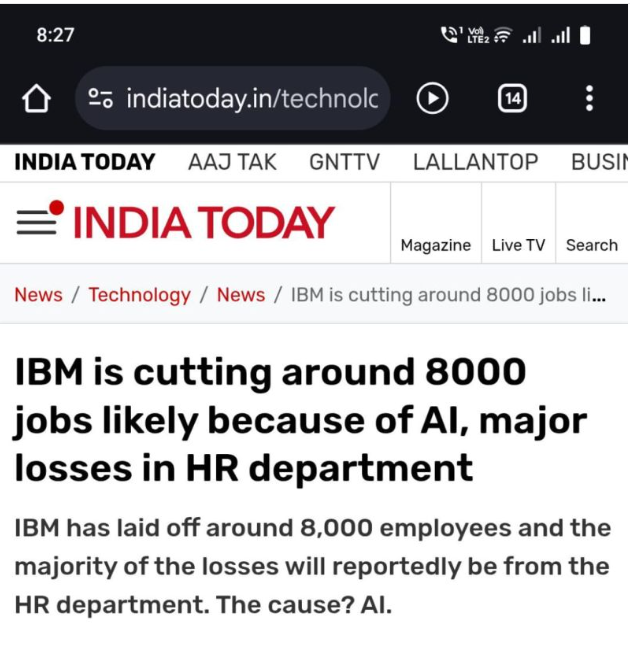
  • IBM Just Fired 8,000 Employees.

    IBM Just Fired 8,000 Employees.

    Most of Them from HR. The Reason? Not What You Think.
    No performance issues. No budget crisis. No media storm.
    Just progress—of the silent, algorithmic kind.
    Earlier this month, IBM let go of over 200 HR professionals in one quiet, clinical move. Replaced not by consultants, not by outsourcing, but by AI agents.
    Then it escalated.
    Over 8,000 roles were eliminated. The majority from HR. No scandal. No warning signs. Just efficiency, at scale.
    Resume screening? Automated. Employee queries? Chatbots. Onboarding, transfers, paperwork? One-click workflows.
    Tasks that once needed teams now require templates.
    This Isn’t Just a Corporate Layoff – It’s the Future of HR Automation
    This Isn’t Just a Layoff.
    It’s a Recalibration of What Work Means in HR.
    The message, if you’re listening, is brutally clear:
    If your work is repetitive, it’s replaceable. If your process isn’t evolving, it’s disappearing.
    And here’s what most news pieces missed: IBM isn’t shrinking. They’re growing.
    Their total headcount is on the rise.
    But while the quantity of employees is up, the quality of roles has shifted. Fewer administrators. More creators. Fewer processors. More problem-solvers.
    They’re not cutting back—they’re reallocating human intelligence toward functions where it actually matters.
    Software. Marketing. Sales. Product development.
    In other words, where AI assists—not replaces.
    The Hard Truth About AI in Human Resources
    HR Needs to Ask a Hard Question:
    Are we building the future—or just reacting to it?
    Because here’s what AI automation in HR doesn’t do:
    • It doesn’t take sick leaves.
    • It doesn’t burn out.
    • It doesn’t delay feedback or misplace a form.
    It’s fast. It’s accurate. And it’s tireless.
    So if your daily work looks like:
    • Copy-pasting data,
    • Chasing approvals,
    • Emailing reminders,
    • Generating reports from Excel—
    Then the truth is uncomfortable: AI isn’t coming. It’s already here.
    And it doesn’t want your badge. It wants your workflow.
    How HR Professionals Can Survive the AI Revolution
    But There’s Still a Way Forward.
    AI won’t kill HR. But HR that refuses to evolve? That’s a different story.
    There’s a new version of HR being born. One that:
    • Designs smarter org structures.
    • Builds predictive models for attrition.
    • Uses AI to personalize employee experience at scale.
    • Partners with technology—not competes with it.
    The IBM layoffs 2025 weren’t just a corporate cost-cutting move. It was a mirror held up to the industry.
    The reflection? Not flattering.
    The Future of Work: Adapt or Be Automated
    Final Thought:
    AI won’t take your job. But someone using AI will.
    The question is: Will you be the one who gets replaced—or the one who builds what comes next?
    ________________________________________
    Are you preparing for the AI transformation in HR? The signs are everywhere. The choice is yours: evolve with technology or risk being left behind.
    Share your thoughts: How is AI already changing your HR work? What skills are you developing to stay relevant?
    ________________________________________

  • “You can’t predict Employee attrition like that.”

    The CHRO said it flatly. Not as a challenge. As a truth of the HR universe. The kind uttered after decades of battling dashboards, gut feel, and last-minute exit interviews.

    I didn’t respond. Just opened my laptop.

    “Watch.”

    He leaned forward. I hit run. Five seconds. The screen blinked.

    A clean report emerged. Not a dashboard. A verdict.

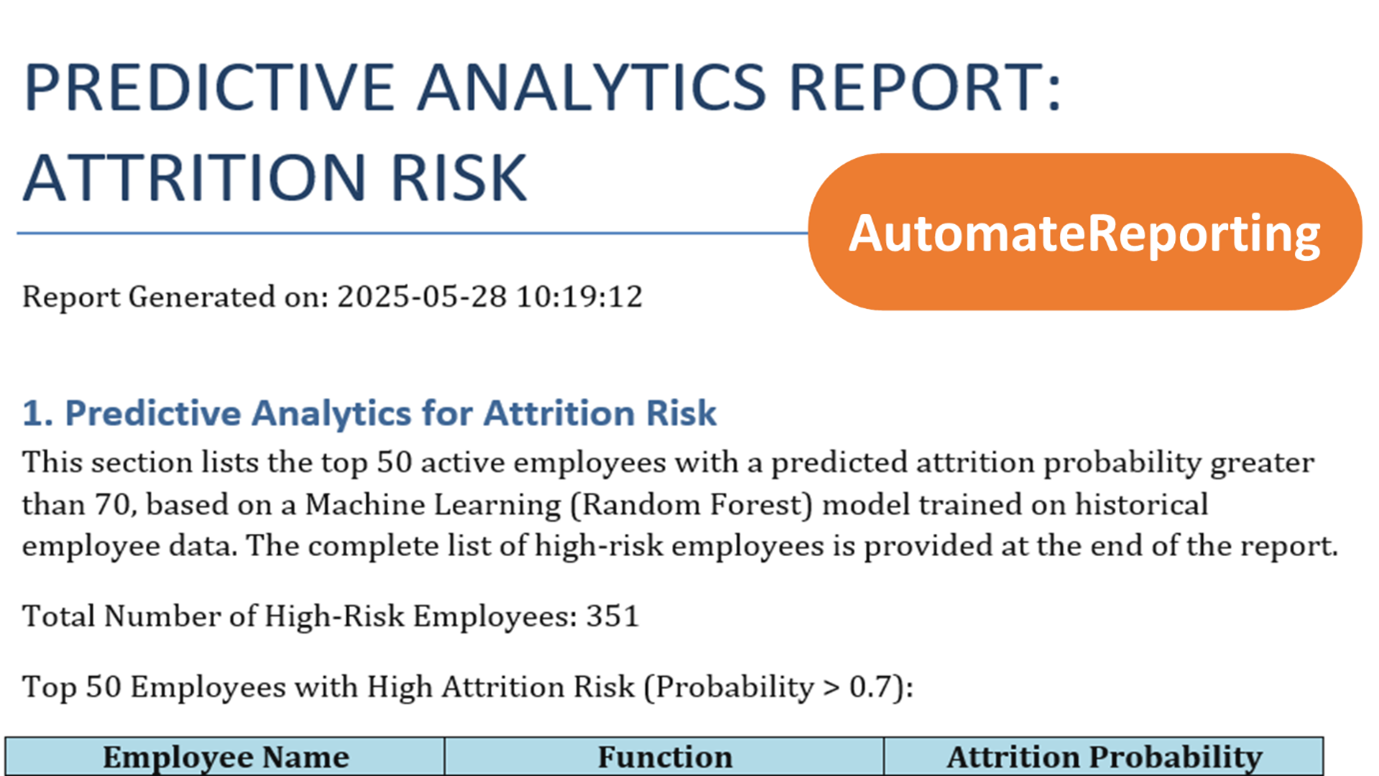
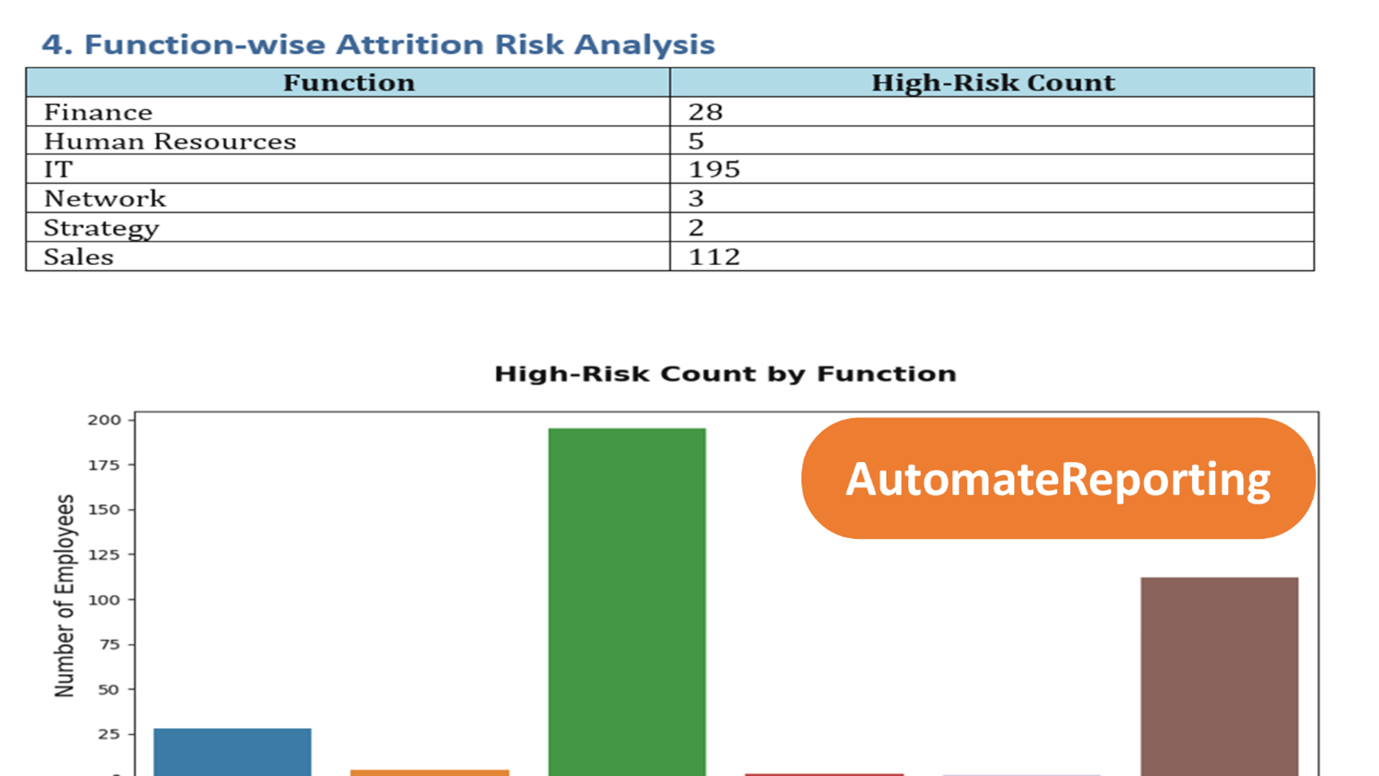
    High-risk employees: 12. Function-wise split: Done. Grade-wise pattern: Flagged. Individual flight risk probabilities: 0.82, 0.76, 0.91…

    95% confidence. Generated in five seconds. By a Random Forest Model trained on separation trackers, tenure trends, compensation shifts, and a few things we’re not supposed to admit HR tracks.

    He looked up. “That’s not how HR works.”

    I smiled.

    Maybe it should be.

    The AI Revolution in HR Analytics: Beyond Traditional Workforce Management

    This wasn’t magic. Just math with purpose.

    We built an AI Agent for employee retention. Not to replace HR judgment—but to upgrade it.

    The predictive analytics system does 3 things HR teams dream of but rarely dare to ask for:

    • Predict employee attrition before it becomes a headline
    • Quantify individual flight risk with probabilities—months in advance
    • Automate workforce analytics reports—by function, location, grade, and tenure

    The AI Revolution in HR Analytics: Beyond Traditional Workforce Management

    This wasn’t magic. Just math with purpose.

    We built an AI Agent for employee retention. Not to replace HR judgment—but to upgrade it.

    The predictive analytics system does 3 things HR teams dream of but rarely dare to ask for:

    • Predict employee attrition before it becomes a headline
    • Quantify individual flight risk with probabilities—months in advance
    • Automate workforce analytics reports—by function, location, grade, and tenure

    No more Excel gymnastics. No more panicked calls before the Board meets. Just actionable insights in place of data noise.

    Why Traditional HR Analytics Fail at Employee Retention

    HR doesn’t need another dashboard.

    It needs decisions.

    Here’s the uncomfortable truth: We’ve spent the last decade building visibility. But very little of it translated to action.

    Predictive AI for HR bridges that gap. Not by giving us certainty, but by refining our doubt.

    When a manager says, “I didn’t see it coming,” you can now ask: “Or did you just not look in the right place?”

    The Transformation: From Reactive to Predictive HR

    So what happened next?

    The CHRO leaned back. Silent for a moment. Then:

    “Can we scale this?”

    Not “Is this real?” Not “Will employees resist?” Just a quiet, serious request: “Can we make this standard?”

    And that’s the shift AI brings to human resources. Not automation. Augmentation. Not replacing judgment. Sharpening it. Not removing the human. Revealing it.

    The Future of Workforce Analytics: Evidence-Based HR Decisions

    Employee attrition prediction will never be fully predictable. But ignorance? That’s now a choice.

    Final thought: In HR, we’ve always had instincts. Now, we have evidence. The question is—will we act on it?

    Ready to transform your HR analytics? The tools exist. The data exists. The only question is whether you’re ready to move from reactive to predictive workforce management. What’s your experience with AI in HR? Share your thoughts in the comments below.

  • Your Complete Guide Through the AI Jungle: From LLMs to Agentic AI

    Your Complete Guide Through the AI Jungle: From LLMs to Agentic AI

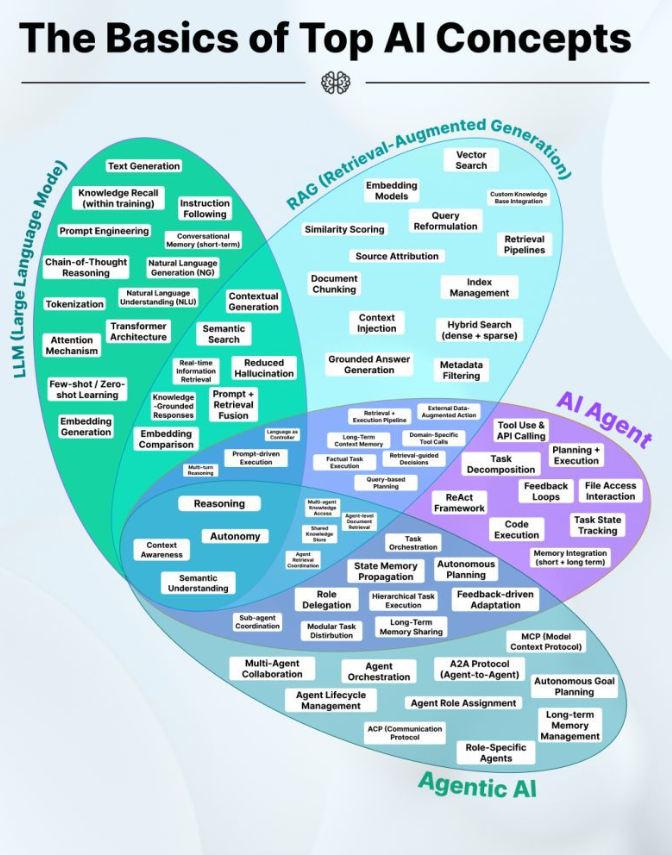
    The AI landscape isn’t a jungle of competing technologies—it’s a carefully architected intelligence stack that every enterprise needs to understand. After implementing AI systems across Fortune 500 companies, I’ve seen firsthand how the most successful organizations treat GenAI as layered infrastructure, not isolated tools.

    Let me break down the four-layer architecture that’s transforming how businesses operate.

    Layer 1: Large Language Models (The Foundation)

    Think of LLMs as your AI’s brain stem—they handle the core language processing that everything else builds on.

    What LLMs Actually Do:

    • Tokenize your text into processable chunks

    • Embed language into mathematical representations

    • Generate coherent, contextual responses

    • Follow instructions with remarkable accuracy

    • Reason through complex problems

    Reality Check: LLMs are incredibly powerful but fundamentally limited. They can’t access real-world data, can’t take actions, and can’t learn from new information. They’re pure language intelligence—nothing more, nothing less.

    Enterprise Applications That Work Right Now:

    • Content generation (I’ve seen 70% time savings in marketing teams)

    • Code completion and documentation

    • Initial customer service responses

    • Data analysis and report generation

    Layer 2: Retrieval-Augmented Generation (The Knowledge Bridge)

    RAG is where LLMs stop hallucinating and start being useful. It connects your AI to real, current information.

    Here’s what RAG actually fixes:

    The Hallucination Problem: LLMs confidently make up facts. RAG grounds responses in your actual data, reducing hallucinations by up to 85% in our implementations.

    How RAG Transforms Your AI:

    • Vector search finds semantically similar content across millions of documents

    • Document chunking breaks your knowledge base into searchable pieces

    • Source grounding links every response back to specific information

    • Real-time access to live databases and APIs

    Game-Changing Use Cases:

    • Internal knowledge management (one client reduced support ticket resolution time by 60%)

    • Compliance and regulatory guidance with audit trails

    • Customer support with product-specific accuracy

    • Research and competitive intelligence

    Layer 3: AI Agents (Where Talk Becomes Action)

    This is where things get interesting. AI Agents are where your AI stops talking and starts doing.

    What Makes Agents Different:

    • Planning: Breaking complex tasks into executable steps

    • Tool usage: Actually calling APIs and interacting with systems

    • State management: Remembering context across multi-step processes

    • Decision making: Choosing the right action based on current situation

    Real Impact: One manufacturing client uses AI agents to manage their entire supply chain exception handling. What used to take hours of human coordination now happens in minutes, automatically.

    Enterprise Agent Applications:

    • Process automation end-to-end

    • Customer journey orchestration

    • IT operations and incident response

    • Sales pipeline management

    Layer 4: Agentic AI (The Orchestration Layer)

    Agentic AI is where multiple intelligent agents collaborate, assign roles, share memory, and pursue complex goals together.

    This isn’t science fiction—it’s happening now in leading enterprises.

    What Agentic AI Enables:

    • Multi-agent collaboration across different business functions

    • Dynamic role assignment based on expertise and workload

    • Shared memory systems creating institutional knowledge

    • Goal adaptation as situations evolve

    • Autonomous coordination without human intervention

    Success Story: A financial services firm uses agentic AI to manage their entire trading operations. Multiple specialized agents handle market analysis, risk assessment, execution, and reporting—collaborating in real-time to optimize portfolio performance.

    How The Complete Stack Works Together

    Here’s a real-world example from customer service:

    1. LLM Layer: Understands customer inquiry in natural language

    2. RAG Layer: Retrieves relevant product documentation and customer history

    3. Agent Layer: Routes tickets, schedules follow-ups, escalates when needed

    4. Agentic Layer: Coordinates across support, billing, and technical teams automatically

    Result: 78% of customer issues resolved without human intervention, 45% faster resolution times.

  • Trends of AI 2025 Latest

    Trends of AI 2025 Latest

    Artificial Intelligence continues to evolve rapidly, driving innovation across industries. Here are key trends to watch in 2025:

    1. Agentic AI Systems

    AI agents that autonomously handle complex tasks, like managing dApps or trading assets, are gaining traction. These systems require minimal user input, making them ideal for Web3 applications.

    2. Human-AI Collaboration

    AI-generated content, like blog posts, performs best when paired with human oversight. Studies show human-assisted AI articles score higher in originality, readability, and SEO compared to fully AI-generated ones.

    3. Cognitive Architectures

    Advancements in AI cognitive frameworks, like those explored by OpenAI, enable models to process language and reasoning more akin to human thought. This is evident in how LLMs align with neural activity during conversations.

    4. AI in Software Development

    Tools like Copilot excel at recreating familiar code patterns but struggle to innovate new frameworks. Human creativity remains essential for groundbreaking tech advancements.

    AI’s future lies in balancing automation with human ingenuity. Stay tuned to blogs like OpenAI, Towards Data Science, and Google Research for deeper insights.