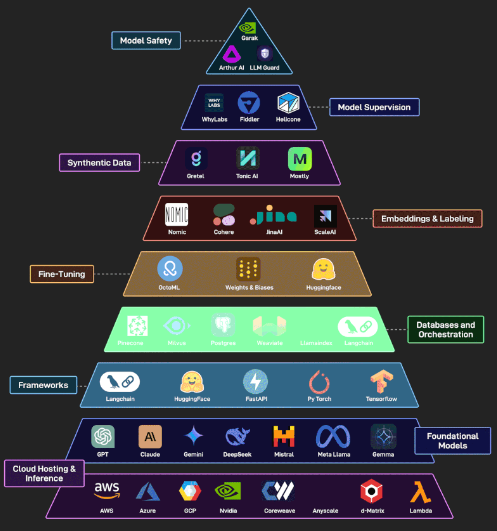
𝗧𝗵𝗶𝘀 𝗶𝘀 𝘁𝗵𝗲 𝗿𝗲𝗮𝗹 𝗚𝗲𝗻𝗲𝗿𝗮𝘁𝗶𝘃𝗲 𝗔𝗜 𝗧𝗲𝗰𝗵 𝗦𝘁𝗮𝗰𝗸 — 𝗹𝗮𝘆𝗲𝗿 𝗯𝘆 𝗹𝗮𝘆𝗲𝗿.
Everyone wants AI magic. But creating real value takes more than just a flashy model — it requires thoughtful architectural decisions across a complex system.
Because the future of AI won’t be shaped by models alone. It will be defined by the systems around them: infrastructure, orchestration, data, and governance. Behind every successful AI product is a series of deliberate, system-level choices — and this is where the real work begins.
𝗨𝗻𝗱𝗲𝗿𝘀𝘁𝗮𝗻𝗱𝗶𝗻𝗴 𝘁𝗵𝗶𝘀 𝘀𝘁𝗮𝗰𝗸 𝗶𝘀 𝗲𝘀𝘀𝗲𝗻𝘁𝗶𝗮𝗹 𝘁𝗼 𝗯𝘂𝗶𝗹𝗱𝗶𝗻𝗴 𝗿𝗲𝗮𝗹-𝘄𝗼𝗿𝗹𝗱 𝗔𝗜 𝘀𝘆𝘀𝘁𝗲𝗺𝘀 — 𝗹𝗲𝘁’𝘀 𝗯𝗿𝗲𝗮𝗸 𝗶𝘁 𝗱𝗼𝘄𝗻:
1. Cloud Hosting & Inference → AWS, Azure, GCP, NVIDIA
– The foundation of every GenAI system — providing the scalable compute and infrastructure required to train and serve models at speed and scale.
2. Foundation Models → GPT, Claude, Gemini, Mistral, DeepSeek
– These are the pre-trained engines of intelligence — capable of reasoning, generating, and adapting across a wide range of tasks and domains.
3. Frameworks → LangChain, HuggingFace, FastAPI
– The orchestration layer that enables developers to build structured workflows, chains, and agent systems on top of large models.
4. Vector DBs & Orchestration → Pinecone, Weaviate, Milvus, LlamaIndex
– Responsible for memory, context retrieval, and connecting unstructured data to
AI systems — critical for applications like RAG and agents.
5. Fine-Tuning → Weights & Biases, HuggingFace, OctoML
– The process and tooling that adapt general-purpose models to specific use cases, industries, or internal knowledge — enhancing relevance and accuracy.
6. Embeddings & Labeling → Cohere, ScaleAI, JinaAI, Nomic
– Transform raw data into structured, machine-understandable formats — powering similarity search, semantic indexing, and supervised learning.
7. Synthetic Data → Gretel, Tonic AI, Mostly
– Used when real-world data is limited or sensitive — generating high-quality, privacy-safe data for training, testing, or simulation.
8. Model Supervision → WhyLabs, Fiddler, Helicone
– Enables visibility into model behavior through monitoring, debugging, and performance tracing — essential for reliability and governance.
9. Model Safety → LLM Guard, Arthur AI, Garak
– Ensures responsible AI by enforcing output filtering, ethical constraints, and compliance — critical for enterprise adoption and trust.
If you want to build AI that lasts, you don’t just need better models — you need better systems.
Kudos to ByteByteGo for this brilliant visual.
Tag: AI Agents
-
Generative AI Tech Stack – Layer by layer
-

Evaluate AI Agents: 9 Must-Have Metrics Now
𝐀𝐈 𝐀𝐠𝐞𝐧𝐭𝐬 𝐚𝐫𝐞 𝐭𝐡𝐞 𝐟𝐮𝐭𝐮𝐫𝐞 𝐨𝐟 𝐰𝐨𝐫𝐤. 𝐁𝐮𝐭 𝐡𝐨𝐰 𝐝𝐨 𝐲𝐨𝐮 𝐚𝐜𝐭𝐮𝐚𝐥𝐥𝐲 𝐞𝐯𝐚𝐥𝐮𝐚𝐭𝐞 𝐢𝐟 𝐚𝐧 𝐀𝐈 𝐀𝐠𝐞𝐧𝐭 𝐢𝐬 𝐠𝐨𝐨𝐝 𝐞𝐧𝐨𝐮𝐠𝐡 𝐭𝐨 𝐭𝐫𝐮𝐬𝐭?
Most people get excited about building agents, but very few know how to measure their true effectiveness. Without the right evaluation, agents can become unreliable, costly, and even risky to deploy.
𝐇𝐞𝐫𝐞 𝐚𝐫𝐞 𝟗 𝐂𝐨𝐫𝐞 𝐅𝐚𝐜𝐭𝐨𝐫𝐬 𝐭𝐨 𝐄𝐯𝐚𝐥𝐮𝐚𝐭𝐞 𝐚𝐧 𝐀𝐈 𝐀𝐠𝐞𝐧𝐭 𝐢𝐧 𝐬𝐢𝐦𝐩𝐥𝐞 𝐭𝐞𝐫𝐦𝐬:
𝟏. 𝐋𝐚𝐭𝐞𝐧𝐜𝐲 𝐚𝐧𝐝 𝐒𝐩𝐞𝐞𝐝
How fast does the agent finish tasks? A 2-second reply feels great, a 10-second lag frustrates users.
𝟐. 𝐀𝐏𝐈 𝐄𝐟𝐟𝐢𝐜𝐢𝐞𝐧𝐜𝐲
Does the agent optimize API calls or combine requests smartly to reduce cost and delay?
𝟑. 𝐂𝐨𝐬𝐭 𝐚𝐧𝐝 𝐑𝐞𝐬𝐨𝐮𝐫𝐜𝐞𝐬
Same result, different costs. One model might cost $0.25 per query, another $0.01. Efficiency matters.
𝟒. 𝐄𝐫𝐫𝐨𝐫 𝐑𝐚𝐭𝐞
How often does the agent fail or crash? If 20 out of 100 attempts fail, that’s a 20 percent error rate.
𝟓. 𝐓𝐚𝐬𝐤 𝐒𝐮𝐜𝐜𝐞𝐬𝐬
Does the agent actually complete the job? If it resolves 45 out of 50 tickets, that’s a 90 percent success rate.
𝟔. 𝐇𝐮𝐦𝐚𝐧 𝐈𝐧𝐩𝐮𝐭
How much correction does the AI need? If humans edit every step, efficiency drops.
𝟕. 𝐈𝐧𝐬𝐭𝐫𝐮𝐜𝐭𝐢𝐨𝐧 𝐌𝐚𝐭𝐜𝐡
Does the AI follow instructions correctly? If asked for 3 bullet points but writes a paragraph, it is failing accuracy.
𝟖. 𝐎𝐮𝐭𝐩𝐮𝐭 𝐅𝐨𝐫𝐦𝐚𝐭
Is the answer in the right format? If JSON is expected but plain text comes back, that breaks workflows.
𝟗. 𝐓𝐨𝐨𝐥 𝐔𝐬𝐞
Does the agent use the right tools? For example, using a calculator API instead of “guessing” math answers.
AI Agents are not just about being flashy. They need to prove they are reliable, cost-effective, and scalable. Evaluating them across these nine factors ensures they’re truly ready for real-world use. -

What Are AI Agents? And Why They’re Not Just Fancy Chatbots
What is an AI Agent?
An AI agent is a software system that can autonomously perceive inputs, reason through options, take actions, and improve its behavior over time — all in service of achieving a specific goal.
Unlike traditional programs or assistants, AI agents are proactive and goal-driven. They:
- Interpret user intent,
- Break down complex tasks,
- Use external tools (e.g., APIs, databases),
- Execute sequences of actions, and
- Learn from outcomes to optimize performance.
In short, they don’t just answer questions. They solve problems. Continuously, intelligently, and often independently.
AI Agent vs. Assistant vs. Bot: A Clear Distinction
Feature AI Agent AI Assistant Bot Purpose Autonomously and proactively perform tasks Assist users with tasks Automate simple tasks or conversations Capabilities Handles complex, multi-step actions; learns, adapts Responds to prompts, provides help Follows pre-defined rules; limited interactions Interaction Proactive; goal-driven Reactive; user-led Reactive; rule-based Autonomy High — acts independently to achieve goals Medium — assists but relies on user direction Low — operates on pre-programmed logic Learning Employs machine learning to adapt over time Some adaptive features Usually static; no learning capability Complexity High — solves enterprise-grade problems Medium — supports workflows Low — designed for repetitive tasks Most people still confuse assistants with agents. But think of it this way:
- A bot asks, “How can I help you?”
- An assistant says, “Here’s how I can help.”
- An agent just gets it done — often before you even ask.
How Do AI Agents Actually Work?
AI agents follow a dynamic loop that mimics high-functioning human workflows:
1. Perception
They take in prompts or triggers (text, voice, system events) and understand them using natural language processing and contextual analysis.
2. Planning
Based on your intent, they break down tasks and decide what to do, which tools to use, and in what sequence.
3. Execution
They perform actions — calling APIs, writing emails, scraping data, querying databases, updating spreadsheets — whatever it takes.
4. Observation
Agents track the outcome of each action and adjust their next step accordingly.
5. Learning
Over time, agents evolve. They analyze feedback and improve how they work — just like a new hire becoming a top performer.
So Why Is This a Big Deal?
Because it changes what software means.
For the first time, we don’t need to use tools. We can hire them.
And in the next post, we’ll explore exactly how agents “think” — and how two major agent paradigms, ReAct and ReWOO, are shaping the future of autonomous systems.
📌 Stay tuned: Next up — ReAct vs. ReWOO: How AI Agents Actually Think
-
Your Complete Guide Through the AI Jungle: From LLMs to Agentic AI
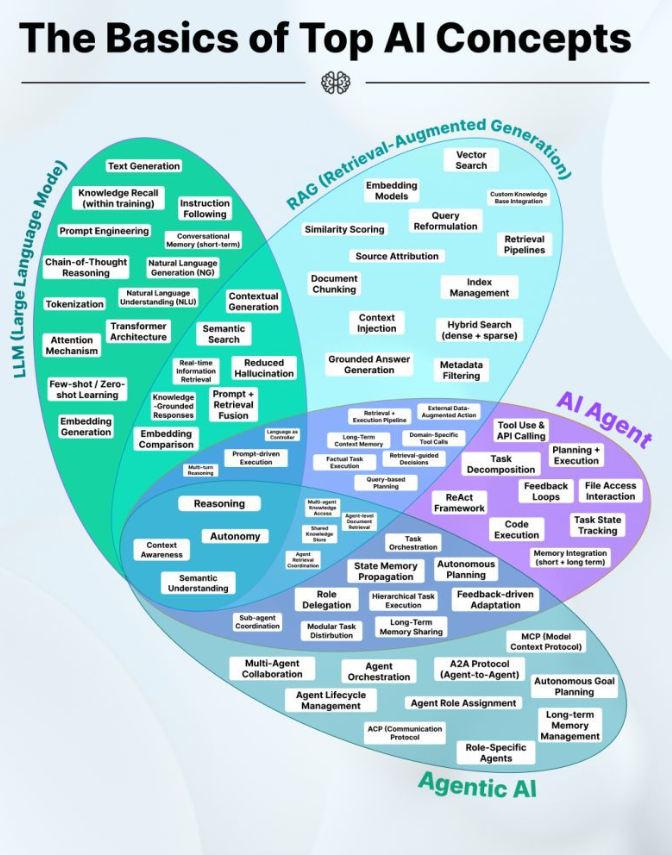
The AI landscape isn’t a jungle of competing technologies—it’s a carefully architected intelligence stack that every enterprise needs to understand. After implementing AI systems across Fortune 500 companies, I’ve seen firsthand how the most successful organizations treat GenAI as layered infrastructure, not isolated tools.
Let me break down the four-layer architecture that’s transforming how businesses operate.
Layer 1: Large Language Models (The Foundation)
Think of LLMs as your AI’s brain stem—they handle the core language processing that everything else builds on.
What LLMs Actually Do:
• Tokenize your text into processable chunks
• Embed language into mathematical representations
• Generate coherent, contextual responses
• Follow instructions with remarkable accuracy
• Reason through complex problems
Reality Check: LLMs are incredibly powerful but fundamentally limited. They can’t access real-world data, can’t take actions, and can’t learn from new information. They’re pure language intelligence—nothing more, nothing less.
Enterprise Applications That Work Right Now:
• Content generation (I’ve seen 70% time savings in marketing teams)
• Code completion and documentation
• Initial customer service responses
• Data analysis and report generation
Layer 2: Retrieval-Augmented Generation (The Knowledge Bridge)
RAG is where LLMs stop hallucinating and start being useful. It connects your AI to real, current information.
Here’s what RAG actually fixes:
The Hallucination Problem: LLMs confidently make up facts. RAG grounds responses in your actual data, reducing hallucinations by up to 85% in our implementations.
How RAG Transforms Your AI:
• Vector search finds semantically similar content across millions of documents
• Document chunking breaks your knowledge base into searchable pieces
• Source grounding links every response back to specific information
• Real-time access to live databases and APIs
Game-Changing Use Cases:
• Internal knowledge management (one client reduced support ticket resolution time by 60%)
• Compliance and regulatory guidance with audit trails
• Customer support with product-specific accuracy
• Research and competitive intelligence
Layer 3: AI Agents (Where Talk Becomes Action)
This is where things get interesting. AI Agents are where your AI stops talking and starts doing.
What Makes Agents Different:
• Planning: Breaking complex tasks into executable steps
• Tool usage: Actually calling APIs and interacting with systems
• State management: Remembering context across multi-step processes
• Decision making: Choosing the right action based on current situation
Real Impact: One manufacturing client uses AI agents to manage their entire supply chain exception handling. What used to take hours of human coordination now happens in minutes, automatically.
Enterprise Agent Applications:
• Process automation end-to-end
• Customer journey orchestration
• IT operations and incident response
• Sales pipeline management
Layer 4: Agentic AI (The Orchestration Layer)
Agentic AI is where multiple intelligent agents collaborate, assign roles, share memory, and pursue complex goals together.
This isn’t science fiction—it’s happening now in leading enterprises.
What Agentic AI Enables:
• Multi-agent collaboration across different business functions
• Dynamic role assignment based on expertise and workload
• Shared memory systems creating institutional knowledge
• Goal adaptation as situations evolve
• Autonomous coordination without human intervention
Success Story: A financial services firm uses agentic AI to manage their entire trading operations. Multiple specialized agents handle market analysis, risk assessment, execution, and reporting—collaborating in real-time to optimize portfolio performance.
How The Complete Stack Works Together
Here’s a real-world example from customer service:
1. LLM Layer: Understands customer inquiry in natural language
2. RAG Layer: Retrieves relevant product documentation and customer history
3. Agent Layer: Routes tickets, schedules follow-ups, escalates when needed
4. Agentic Layer: Coordinates across support, billing, and technical teams automatically
Result: 78% of customer issues resolved without human intervention, 45% faster resolution times.