
Tag: Business Intelligence

  • The Unsexy Core of Analytics: Confessions of a Data Janitor (Part 2)

    Monday, 9:12 AM.

    I was sipping tea, staring at a headcount file that looked like it had survived five data migrations and one senior leader’s existential crisis.

    • Employee IDs were missing. • Date of joining? 1894. • One row had “Not sure” under gender.

    And just as I took my first proper sip, came the ping:

    “Hey, can you run some quick analytics?”

    Ah yes. The word “quick.” The cruel joke we analysts keep hearing from people who think Excel macros are AI.

    Everyone Wants Dashboards. Nobody Wants the Mop.

    We live in a world obsessed with shiny dashboards. KPI temples. Power BI fortresses. Tableau art shows.

    But behind every beautiful dashboard is a sweaty analyst cleaning an Excel sheet like a crime scene investigator.

    Let me say this straight: Analytics doesn’t start with insight. It starts with mops.

    And if you’re not ready to clean, decode, and question your data line-by-line—you’re not ready for analytics.

    Column by Column: Become a Translator, Not Just a Techie

    Let’s pick one column: “Employee Grade.”

    Sounds simple, right?

    Until you meet:

    • “G4” • “Grade 4” • “04” • “g IV”

    They might mean the same thing. But if you assume they do without context, congratulations—you’ve just built a trendline on trash.

    Before you model, you decode. Before you automate, you understand.

    Every column has a dialect. Your job? Become a linguist for logic.

    Row by Row: Build Context Before You Code

    People data isn’t like inventory data. It’s messy because people are messy.

    Take five rows from your HRIS or ATS system. Read them like a forensic analyst.

    • Why is “Team” blank in Row 27? • Why does one entry have two DOJs? • Who wrote “?!” under Reporting Manager?

    This isn’t wasting time.

    This is how you learn the terrain. And no automation replaces that gut feel built from reading chaos firsthand.

    Mastery Lives in the Mess

    The deeper you go in analytics, the more you realize: The boring stuff is the real stuff.

    It’s cleaning mismatched hierarchies. It’s understanding why attrition spiked after an org restructure no one documented. It’s spotting that one broken formula hiding in a legacy column named “zz_dummy_temp_3.”

    Because I’ve seen it—more than once:

    A CEO taking big strategic calls off a dashboard built on bad joins, old logic, and blind assumptions.

    That’s not analytics. That’s gambling with a PowerPoint.

    Real Analysts Don’t Chase Dashboards. They Chase Truth.

    So, next time someone says:

    “Just give me some quick insights.”

    Smile.

    Open the mop bucket. And start cleaning like a pro.

    Because the truth is never shiny. It’s usually hidden under layers of copy-paste, human error, and mystery abbreviations.

    If you’re just starting in AI or Analytics, don’t fear the mess. Own it. Question it. Learn from it.

    The trendline is just the tip. The real story? It’s buried in the row where someone wrote “NA” under Exit Reason—but also marked “Terminated” in Action Type.

    Got a nightmare HRIS row or analytics horror story? Drop it in the comments—I might feature it in Part 3.

    Because every analyst has a data ghost story. And every great one knows: the truth isn’t in the trends. It’s in the cleanup.
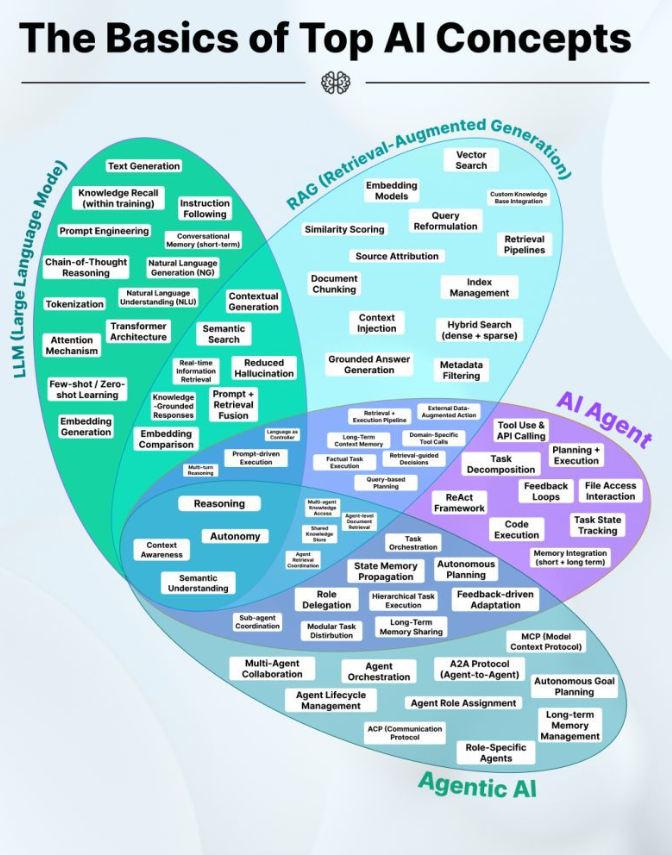
  • Your Complete Guide Through the AI Jungle: From LLMs to Agentic AI

    Your Complete Guide Through the AI Jungle: From LLMs to Agentic AI

    The AI landscape isn’t a jungle of competing technologies—it’s a carefully architected intelligence stack that every enterprise needs to understand. After implementing AI systems across Fortune 500 companies, I’ve seen firsthand how the most successful organizations treat GenAI as layered infrastructure, not isolated tools.

    Let me break down the four-layer architecture that’s transforming how businesses operate.

    Layer 1: Large Language Models (The Foundation)

    Think of LLMs as your AI’s brain stem—they handle the core language processing that everything else builds on.

    What LLMs Actually Do:

    • Tokenize your text into processable chunks

    • Embed language into mathematical representations

    • Generate coherent, contextual responses

    • Follow instructions with remarkable accuracy

    • Reason through complex problems

    Reality Check: LLMs are incredibly powerful but fundamentally limited. They can’t access real-world data, can’t take actions, and can’t learn from new information. They’re pure language intelligence—nothing more, nothing less.

    Enterprise Applications That Work Right Now:

    • Content generation (I’ve seen 70% time savings in marketing teams)

    • Code completion and documentation

    • Initial customer service responses

    • Data analysis and report generation

    Layer 2: Retrieval-Augmented Generation (The Knowledge Bridge)

    RAG is where LLMs stop hallucinating and start being useful. It connects your AI to real, current information.

    Here’s what RAG actually fixes:

    The Hallucination Problem: LLMs confidently make up facts. RAG grounds responses in your actual data, reducing hallucinations by up to 85% in our implementations.

    How RAG Transforms Your AI:

    • Vector search finds semantically similar content across millions of documents

    • Document chunking breaks your knowledge base into searchable pieces

    • Source grounding links every response back to specific information

    • Real-time access to live databases and APIs

    Game-Changing Use Cases:

    • Internal knowledge management (one client reduced support ticket resolution time by 60%)

    • Compliance and regulatory guidance with audit trails

    • Customer support with product-specific accuracy

    • Research and competitive intelligence

    Layer 3: AI Agents (Where Talk Becomes Action)

    This is where things get interesting. AI Agents are where your AI stops talking and starts doing.

    What Makes Agents Different:

    • Planning: Breaking complex tasks into executable steps

    • Tool usage: Actually calling APIs and interacting with systems

    • State management: Remembering context across multi-step processes

    • Decision making: Choosing the right action based on current situation

    Real Impact: One manufacturing client uses AI agents to manage their entire supply chain exception handling. What used to take hours of human coordination now happens in minutes, automatically.

    Enterprise Agent Applications:

    • Process automation end-to-end

    • Customer journey orchestration

    • IT operations and incident response

    • Sales pipeline management

    Layer 4: Agentic AI (The Orchestration Layer)

    Agentic AI is where multiple intelligent agents collaborate, assign roles, share memory, and pursue complex goals together.

    This isn’t science fiction—it’s happening now in leading enterprises.

    What Agentic AI Enables:

    • Multi-agent collaboration across different business functions

    • Dynamic role assignment based on expertise and workload

    • Shared memory systems creating institutional knowledge

    • Goal adaptation as situations evolve

    • Autonomous coordination without human intervention

    Success Story: A financial services firm uses agentic AI to manage their entire trading operations. Multiple specialized agents handle market analysis, risk assessment, execution, and reporting—collaborating in real-time to optimize portfolio performance.

    How The Complete Stack Works Together

    Here’s a real-world example from customer service:

    1. LLM Layer: Understands customer inquiry in natural language

    2. RAG Layer: Retrieves relevant product documentation and customer history

    3. Agent Layer: Routes tickets, schedules follow-ups, escalates when needed

    4. Agentic Layer: Coordinates across support, billing, and technical teams automatically

    Result: 78% of customer issues resolved without human intervention, 45% faster resolution times.