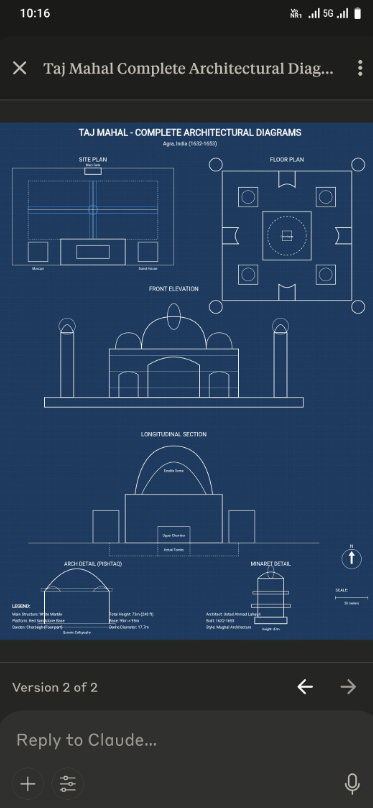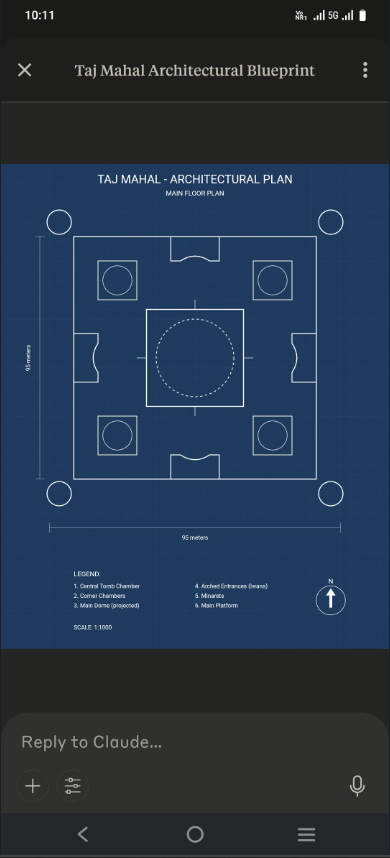
I Used AI to Recreate the Taj Mahal. The Model Crashed Twice. Here’s Why That’s the Point.
A few nights ago, I fed a ridiculous prompt to an AI model.
“Design the architectural blueprints of the Taj Mahal.”
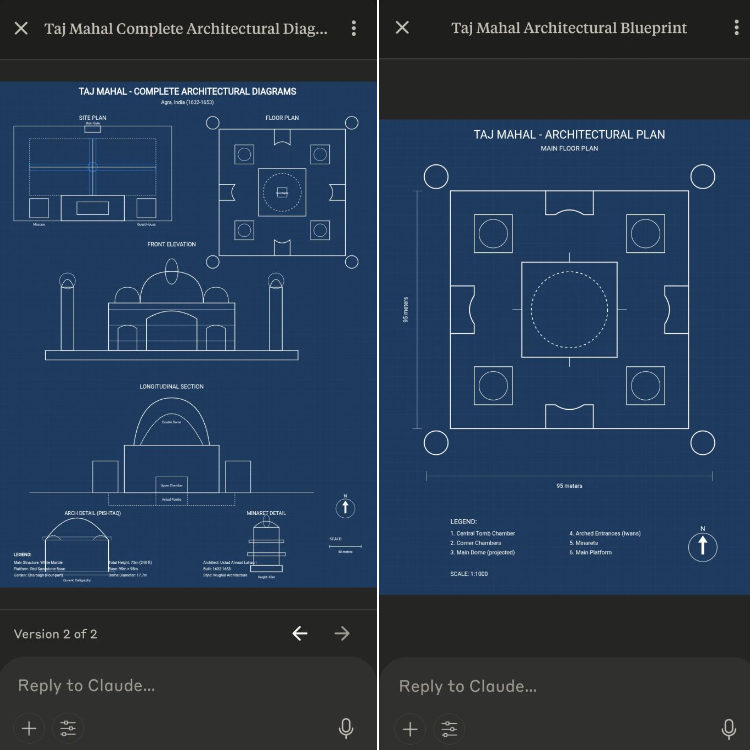
And it did.
Domes. Minarets. Symmetry. The AI creativity surpassed what even textbooks capture, bringing architectural precision to life through artificial intelligence.
Then I got ambitious—and asked it to draft an entire project plan.
Dependencies, timelines, labor estimates, procurement schedules—like a 17th-century Jira board. It crashed my language model. Twice.
And yet, that crash told me more than any success could.
This Wasn’t a Stunt. It Was a Stress Test.
Because the Taj Mahal isn’t just a building. It’s a metaphor.
It was commissioned with vision, executed with rigor, and built on method. And that’s exactly what AI is made for.
We keep looking at AI as if it’s magic—some genie that writes poems, cracks jokes, or designs logos. But that’s the performance art version of artificial intelligence.
What AI creativity really excels at is something deeper, quieter:
Reconstructing anything that’s built on rules, repetition, and structure through artificial intelligence.
- Architecture and creative design
- HR dashboards and analytics
- Financial reports and forecasting
- Onboarding journeys and user experience
- SOP documents and process automation
- Learning paths and educational content
- Even your Monday sales forecast powered by AI
If it follows a logic, it can be reimagined through AI creativity.
That’s not scary. That’s liberating.
Creativity Was Never in Danger. Routine Disguised as Creativity Is.
There’s a certain kind of “creativity” we’ve all been guilty of—work that artificial intelligence now exposes for what it really was.
The PowerPoint slide deck with four mandatory bullet points. The recruitment email template slightly reworded for the hundredth time. The policy document that just adds last year’s change log in a different font.
We called it knowledge work. But really, it was structured imitation. Stylized repetition. Creativity-by-format that AI creativity can now handle with ease.
And artificial intelligence eats that for breakfast.
Because it doesn’t get tired. It doesn’t need inspiration. And it certainly doesn’t care about formatting rules from 2006.
The Blueprint Has Changed.
This isn’t about layoffs or fears. It’s about clarity.
If AI can create the blueprint of one of the world’s greatest architectural wonders through artificial intelligence creativity— what else can it recreate in your workflow?
Think of every job that relies on:
- Predictable rules
- Set steps
- Standardized outputs
- Repeatable logic
- Well-documented inputs
That’s not creative chaos. That’s operational discipline. And that’s precisely what artificial intelligence can do better, faster, and more reliably than human creativity alone.
This isn’t a call to fear. It’s a call to focus.
Are You Still Drawing With the Old Pencil?
Because the blueprint is different now.
It doesn’t start on graph paper. It starts with a prompt—where human creativity meets artificial intelligence.
You don’t need to be an AI engineer. You just need to understand your own workflow deeply enough to hand it over to a machine—and know what creative elements to keep for yourself.
AI won’t replace your vision or creative thinking. But it will quietly take over everything that pretended to be creative but was really just habit.
The Taj Mahal didn’t need artificial intelligence to exist. But today, it needs AI creativity to be explained, replicated, and scaled in seconds.
What else in your world is waiting to be reimagined?