Artificial intelligence isn’t just knocking at the door. It’s moved in, rearranged the furniture, and now it’s eyeing your organizational chart.
The latest McKinsey Global Survey on artificial intelligence reveals that the winners in the generative AI race aren’t necessarily the most tech-savvy companies. They’re the best organized. The real disruptor? AI leadership structure and organizational design.
Welcome to Part 1 of our comprehensive 2-part series on how companies are organizing for generative AI success. Today, we examine AI leadership, centralization strategies, and organizational scale. Part 2 will explore AI workflows, risk management, and execution best practices.
CEO Leadership in AI Governance: The Primary Success Factor
McKinsey’s most significant finding? CEO oversight of AI governance is the number one predictor of bottom-line impact from generative AI implementation.
Not AI model quality. Not cloud infrastructure maturity. Not data architecture sophistication. Just one critical factor: executive accountability for AI strategy.
Only 28% of AI-using organizations have CEOs directly owning AI governance responsibilities. However, at enterprise companies over $500M in revenue, this CEO leadership correlates strongly with measurable EBIT growth from AI initiatives.
Why does CEO involvement in AI governance matter so much? Because successful AI transformation isn’t a technology project—it’s a comprehensive business transformation requiring: cross-functional orchestration, bold resource reallocation, and cultural transformation. In other words, C-suite territory.
Some organizations take this even further—17% involve board-level AI oversight. Artificial intelligence has officially become a boardroom priority.
AI Centralization Strategy: Selective Approach for Maximum Impact
The next crucial insight from the research? Selective AI centralization strategies outperform both fully centralized and completely decentralized approaches.
Successful companies centralize foundational AI elements that require uniform standards across the organization:
- AI risk management and compliance
- Enterprise data governance for AI
- Responsible AI policies and ethics
These foundational elements run through AI Centers of Excellence that establish guardrails for the entire organization.
Simultaneously, they distribute AI execution elements where domain expertise and local context matter most:
- AI solution implementation
- Business use-case identification
- AI talent deployment and training
This approach combines centralized AI governance with distributed innovation. Think: enterprise AI playbooks enabling local experimentation.
Enterprise Scale Advantages in AI Transformation
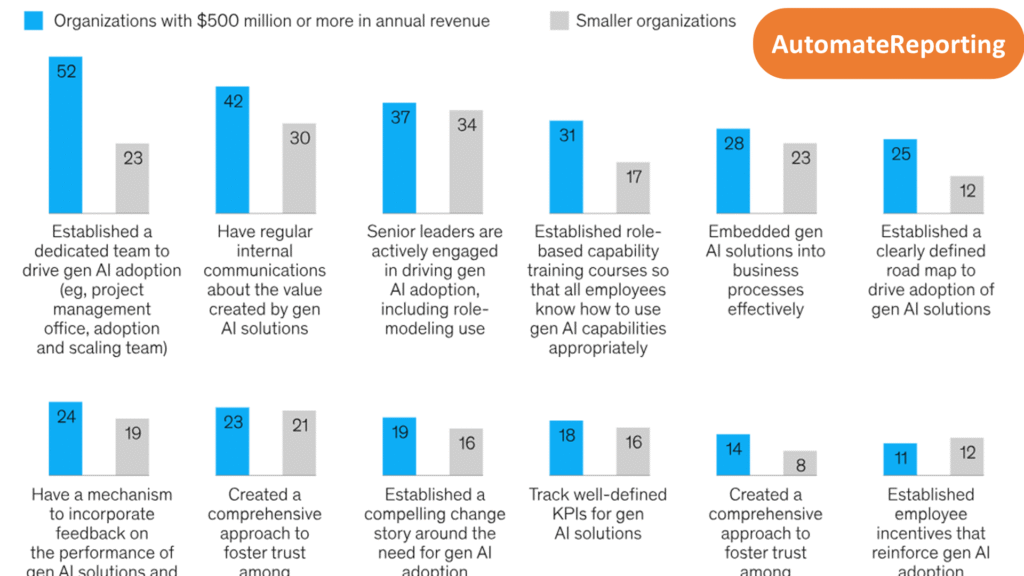
Organizational size significantly impacts AI adoption success. Larger enterprises ($500M+ annual revenue) demonstrate more than twice the likelihood to:
- Establish comprehensive AI roadmaps and strategies
- Build dedicated AI transformation teams
- Implement enterprise AI governance frameworks
These represent systematic AI transformations, not isolated pilot projects.
However, smaller companies possess distinct competitive advantages: operational agility, faster decision-making, and minimal legacy system constraints. The window for AI first-mover advantage remains open for organizations of all sizes.
Current State of Enterprise AI Maturity
Despite widespread AI discussion, only 1% of companies describe their generative AI rollouts as “mature.” This statistic represents both a challenge and a significant market opportunity.
The strategic opportunity? Organizations can establish competitive advantages while industry best practices are still emerging. Building foundational AI capabilities now positions companies for long-term success.
Essential AI Leadership Actions for 2025
Based on McKinsey’s research findings, four critical organizational moves emerge:
1. Elevate AI Governance to Executive Leadership AI strategy requires C-suite ownership, not IT department delegation. Executive leadership ensures AI initiatives align with business objectives.
2. Implement Selective AI Centralization Centralize governance, risk management, and data standards. Distribute implementation and use-case development for maximum agility.
3. Approach AI as Organizational Transformation Successful AI adoption requires cultural evolution, not just technology implementation. Organizational structure, incentives, and processes must adapt.
4. Establish Multi-Stakeholder AI Ownership Shared AI governance across departments outperforms single-function ownership models.
Next Steps in AI Organizational Design
This comprehensive guide focuses on deploying AI tools effectively by redesigning organizational foundations.
In Part 2 of this series, we’ll explore:
- AI workflow redesign strategies for operational excellence
- Scalable AI use case development methodologies
- AI risk management frameworks that enable innovation
This decade belongs to organizations that structure for AI success early.
The critical question isn’t whether your company will use artificial intelligence. It’s whether your organizational structure will enable AI to succeed.
Key Takeaways:
- CEO oversight of AI governance correlates directly with business impact
- Selective centralization outperforms fully centralized or decentralized AI approaches
- Enterprise scale provides systematic advantages, but smaller companies can leverage agility
- Only 1% of companies have mature AI deployments, creating first-mover opportunities
Research Source: McKinsey Global Survey on AI (2024) – comprehensive cross-industry study analyzing how companies structure for AI-driven business impact.